From Andraelity, how CODE using math.
In thy following lines we are going to verify or create the connexion that would allow us to unite code with mathematics
Shaders
We are going to detail information and ideas that could help us clarify from which place all this properties came from in a more cohesive and organized way to validate that every single proof that we set
is presented in an order that could help us understand the reasons of equality that could elevate in the future to a order of probabilities, the orders we are structuring right now are base entirely on very well
define amounts, that we could follow in a relationship of quantity, a quantity of numbers that we could start to count, and keep counting till we are able to reason about more inmense and overlimited set of items.
Computer Graphics
Shaders
$$ \begin{aligned}
&\text{he computer runs all the graphics interfaces through the chips, which is nothing else but a bunch of} \\
&\text{organizers or sieves, that reorder the on's and off's from thousands and millions of switches, which only purpose} \\
&\text{is to direct and redirect or sieve, the electric current, electricity, the power, the force through } \\
&\text{to the desired path, so the idea here is not understand something so simple, this is basically changing a bulb} \\
&\text{and turn on the switch to check if it turn up or not, the idea here is visualize what it is the best way} \\
&\text{to change all the bulbs of an stadium capable to alocate 200.000 kThousands people, and not just change} \\
&\text{the bulbs but also change the wired system that runs through all of them, all of a sudem changing one bulb } \\
&\text{seems like a really easy task.} \\
\\[5pt]
&\text{But why thinking this inmense and enormous, is necesary, I only need to plot a single sine function} \\
&\text{i could do it by hand, if doing such thing is that difficult I would prefer to do that, is maybe} \\
&\text{what you are thinking now, and yeah, you're in the freedom to do whatever you think is best, but if your} \\
&\text{idea is to think about something really specific, and really punctual, which requires you to learn} \\
&\text{about this particular type of things, about this specific and punctual ways to think, then yes, you got} \\
&\text{to start thinking very inmense, so thinking little is a little bit more simple.} \\
\\[5pt]
&\text{So now we begin, what are these sieves you'll be thinking, well, easy, sum this two numbers could be a sieve, } \\
&\text{substract this two numbers, could be another sieve, make this number equal to this other number, is anoother one,} \\
&\text{multiply, compare, divide, greater and less than, is another way to create ways to separate and filter information} \\
&\text{verify trueness, which means if the thing is true or false, and when I say thing I mean 1 is equal to 1, if yes then } \\
&\text{continue with the next things to do.}\\
\\[5pt]
&\text{so that`s basically computing in its purest form, thats all the computer does all the time, in many many many ways to }\\
&\text{reorganize summations, comparations, multiplication, evaluation, and also one of the most important ones, }\\
&\text{create new things, stablish new information, save information, or also save this number, save this information you are reading,}\\
&\text{maybe it is useful in the future.}\\
\\[5pt]
&\text{so that's basically doing computing, that's all a computer does, in many, maaanyyyy ways, different ways but }\\
&\text{at the end the same thing, at the end the same same same thing, so if you now know what's really going on }\\
&\text{how much of this things you could think of out a doing }\\
&\text{1 trillions}\\
&\text{1 quatrillions}\\
&\text{1 quintilloins}\\
&\text{1 or maybe you could just think that everything that is going around you, works like that}\\
&\text{that everything that goes in your reality works like that, that everything is a summation}\\
&\text{a substraction, a reorganization of data a store and load of information in very particular ways to make everything }\\
&\text{looks different but the same, at the same time, so maybe is life a simulation maybe you are reading letters that }\\
&\text{only appear in front of you when you are reading them, and everysingle time that you save something is only the illusion}\\
&\text{that you image yourself really doing something.}\\
&\text{so is a decaheptaoctasextaatrillion of things, doesnt sountd that big.}\\
\\[5pt]
&\text{so the idea behind computers or more specificly science, is that you could alter the things in reality}\\
&\text{if the things are organized in a correct order, or fashion, something that you can think is basically a }\\
&\text{representation of this amounts, this inmense number of operations}\\
\\[5pt]
&\text{so how much pixels are on a screen like 2 million ? yeah something like that right, 1920 * 1080}\\
&\text{really small, dont you think, but how many transistors are on a chip, like 10 billion}\\
&\text{but why 10 billion if I only got 2 million pixels, and that's where everything hides behind}\\
&\text{how many screens are really running on your chip, on your computer, how many screens }\\
&\text{are being sum at other things, compare, substracted, how many data on your screen can be presented}\\
&\text{in other strings, in oder words, in other numbers, how many screens are on your computer, }\\
&\text{or more clearer, how many screens can you handle, hey wait a minute I only use one screen what the hell }\\
&\text{are you talking about. Simple, suppose that you are on a cafe internet, the old ones, where people used to sit}\\
&\text{one next to the other, now if you follow this structure, could you simulate that expression on your screen}\\
&\text{it is possible to create an simulation on your computer using math and code to create a cafe}\\
&\text{internet, yes for sure, so if you can simulate computers in a computers, are you simmulating a computer}\\
&\text{or just making use of your computer more extended.}\\
\\[5pt]
&\text{thats usually the most difficult idea to get on, that within your computer there are more computers, }\\
&\text{that you could make use of, if you know how to work with them, so making use of this screens or computers }\\
&\text{is what you need to understand, how to make use of computer more throughfully, how to use computers}\\
&\text{to use more computers, like painting, or building houses, learn how to build houses today, so you could }\\
&\text{build more houses tomorrow, or painting, paint something today so you could make more paints in the future}\\
&\text{so imagine that within your computer there are hundres or thousands or millions of screens, that you could}\\
&\text{could use to display things on.}\\
\\[5pt]
&\text{you could display mathematical plots, like we are going to do from this moment on, or }\\
&\text{you could write words on it, or you could create pictures, or used to create diagrams}\\
&\text{to edit videos, to edit images, to simulate environments, to 3D expand multiple screens so}\\
&\text{you image yourself automatizing machines, design plans, chat or whichever you think is best}\\
&\text{but yeah you got hundrds of screens on your computer available to extend, achieve, and reach your goals,}\\
&\text{but overall try to accomplish what you choise.}\\
\end{aligned}$$
$$\LARGE\text {Shaders}$$
$$\begin{aligned}
&\bullet \text{Read from memory:} && [STACK] \to \text{DATA} \\
&\bullet \text{Write to memory:} && \text{DATA} \to [STACK] \\
&\bullet \text{Add:} && a + b \to \text{DATA} + \text{DATA}\\
&\bullet \text{Subtract:} && a - b \to \text{DATA} - \text{DATA}\\
&\bullet \text{Branch on Zero/False:} && \text{if } Z = 0 \to \text{DATA} = 0\\
&\bullet \text{Branch on One/Positive:} && \text{if } Z = 1 \to \text{DATA} = 1
\end{aligned}$$
$$\\[5ex]$$
$$\begin{aligned}
&\text{The previous instructions define what a computer is, and what can you do to make a computer work}\\
&\text{}\\
&\text{So if we understand now that every computer chip today, got thousands and thousands of computers, inside the }\\
&\text{the question, start to turns into what can you do to change this computers to do what you want to do}\\
&\text{now I got for you a question, can you link a computer to a pixel ?, can you place a single computer }\\
&\text{inside your pixel, can you place a computer inside 2 million pixels, the answer is yes but no,}\\
&\text{its is possible yes, it is currently working like that no, so what is really happening is that each pixel}\\
&\text{is link through a space in your computer chip that sends the information to the screen, once is all updated,}\\
&\text{but before the screen is updated there is a single computer with the rules that we specify above dedicated to}\\
&\text{each pixel.}\\
&\text{So why instead not only one computer to all the pixels?, well thats a nice question, and the answers is }\\
&\text{yes, that's how everything use to work in the past, when computers started, the main way how they used to }\\
&\text{handle the operation, was like that, but at time past, and everything start to get tighter and tighter then}\\
&\text{we start to notice; hey, you know what I can do the same thing I am doing with 1 single computer with 2 milloin }\\
&\text{of them, and even faster.}\\
&\text{The reason why is faster, is cuz compare things is slower than to make calculations, calculations is fast really}\\
&\text{fast!!, like super, super, fast. }\\
&\text{So, now you know got the idea of what we are going to do, we are going to perform calculation on multiple }\\
&\text{computers, at the same time, to graph, or plot things on the screen, thats the main goal, and the reason how, }\\
&\text{is cuz doing that thing is extremelly fast.}\\
&\text{}\\
\end{aligned}$$
$$\begin{aligned}
&\text{So the idea here is to understand that every single computer is run by another computer, that a way for us to }\\
&\text{understand more computer was create more computers to make use of, so we got to invent a way to name this new }\\
&\text{computers so everything dont get messup in the process, so instead of detailing computers version 2,3,4,5....}\\
&\text{ we instead started to name them like shaders, cores, thread, parallelize, kernel, virtualize, and}\\
&\text{etc, etc, etc...}\\
&\text{instead imagine the computers using others computers in a different way, with the purpose to achieve a goal.}\\
&\text{now what we are going to do is define how we can make use of a version of computers names shaders}\\
&\text{which is the closets way to make use of the graphic structures.}\\
&\text{The director is the computer that runs the compiler, which is the programming language of your choice,}\\
&\text{and that allows you to create the layers between the chip and the GPU interface }\\
&\text{so this is going to be the first way to connect the two points, the CPU is the place where you are going}\\
&\text{to use this programming language, to use the layers to share information with your graphics card}\\
&\text{which is the one who would take care of the displaying of your plots, offcourse there is a way to make}\\
&\text{this in the CPU, but is more manageable to do that in the GPU.}\\
&\text{So the GPU is the one which can operate this idea of millions of computers in a more clearer way.}\\
&\text{the main language of your choice is going to be the one who is going to direct which computers}\\
&\text{at which times, and in which way they are going to behave.}\\
&\text{imagine as if you were running your program by launching a command run, but instead you are running programs}\\
&\text{inside a programming language, which create the communication between the next layer of abstraction}\\
&\\[5ex]
&\text{Launching the computers is the key cuz thats whats going to allow you to ordenate things a little bit }\\
&\text{more clearer, mathematics is the key, make use of mathematics is the main idea here, learn how to }\\
&\text{make use of the ways to graphics functions things is what we need to do.}\\
&\text{now what we are going to do is make use of shaders by setting this thing up only to run shaders}\\
&\text{just one shaders, and we are going to get exhaust to make use of this thing}\\
&\text{there's million of things that we could write on a shader.}\\
&\text{So we are going to project many things in shaders, so we could make really nice graph in the future.}\\
&\\[5ex]
&\text{What we now know about shaders is that they work as computers, but you also know that within a shader there are}\\
&\text{also hundreds of computers, them which run in parallel, which only mean that current-electricity runs through it}\\
&\text{making all the computers inside the shader to run at the same time, all the single computers running at the same}\\
&\text{time, every single computer executed at the same time, and we can make these high number of computers to work }\\
&\text{how we wanted, and how we can do that is the key point here, we got to understand them before hand; we got to}\\
&\text{learn how to make use of them so we can make use of them.}\\
&\text{The question here is how we can make thousands of mini computers inside the shader to work how we want,}\\
&\text{which means output what we want them to output.}\\
&\text{}\\
\end{aligned}$$
Shader Snippet
    CGPROGRAM

    #pragma vertex vert alpha
    #pragma fragment frag alpha

    #include "UnityCG.cginc"

    struct VertexInfo
    {
        float2 uv : TEXCOORD0;
        float4 vertex : POSITION;
    };

    struct PixelData
    {
        float2 uv : TEXCOORD0;
        float4 vertex : SV_POSITION;
    };

    sampler2D _MainTex;

    float4 _MainTex_ST;

    int _SetScreen ;
        float _StepTime; // This receives the value from C#

        PixelData vert (VertexInfo v)
    {
        PixelData o;
        o.vertex = UnityObjectToClipPos(v.vertex);
        o.uv = TRANSFORM_TEX(v.uv, _MainTex);
        return o;
    }

    fixed4 frag (PixelData i) : SV_Target
    {

        // THIS CODE MEANS
        // HOW TO RUN THE PIXELS OF THE SCREEN.

        float2 uv =  i.uv ;

        fixed4 colorWhite = float4(1,1,1,1); // Color white.
        fixed4 colorBlack = float4(0,0,0,1); // Color Black.

        col = fixed4(uv.x, uv.y , 0.0, 1.0);
        return col;
    }

    ENDCG
$$\begin{aligned}
&\text{What we we need to do now first of all is to explain how to make use of this pixel computers.}\\
&\text{to do such thing we got to create and environment where we can identify where the computing can happen.}\\
&\text{Lets explain all this stages.}\\
\end{aligned}$$
    CGPROGRAM
    #pragma vertex vert alpha
    #pragma fragment frag alpha

    #include "UnityCG.cginc"
$$\begin{aligned}
&\text{for each pixel and vertex. depending to which type of geometry you are writing them for}\\
&\bullet \text{\textbf{\large {the "CGPROGRAM"}}, headline tag define the start of the program for the shader, which then is going to run }\\
&\text{on your GPU, imagine as if you were running your program in your console, but instead of running it in your }\\
&\text{you run it on the GPU.}\\
&\bullet\text{\textbf{\large {\#pragma}} vertex vert alpha and \#pragma fragment frag alpha, are flags that allow the program to run }\\
&\text{specificly on a section of the GPU, and that it should provide the rest of the run program with the }\\
&\text{functions for the vertex and fragment shader, so it verifies when the function outputs. }\\
&\bullet\text{\textbf{\large {\#include "UnityCG.cginc"}}, is a library that would allow you to make use of integrated functions and }\\
&\text{methods build upon unity, that we are going to use in the future to make uses of the engine which is UNITY, }\\
&\text{to create layers of abstraction between the different qualities of an already created environment. }\\
\end{aligned}$$
    struct VertexInfo
    {
        float2 uv : TEXCOORD0;
        float4 vertex : POSITION;
    };

    struct PixelData
    {
        float2 uv : TEXCOORD0;
        float4 vertex : SV_POSITION;
    };
$$\begin{aligned}
&\bullet\text{\textbf{\large {struct VertexInfo and struct PixelData}} , the next lines are going to allow us to directly specify on the chip }\\
&\text{which information we need to use and which is going to be the name that we are going to use to make use of them.}\\
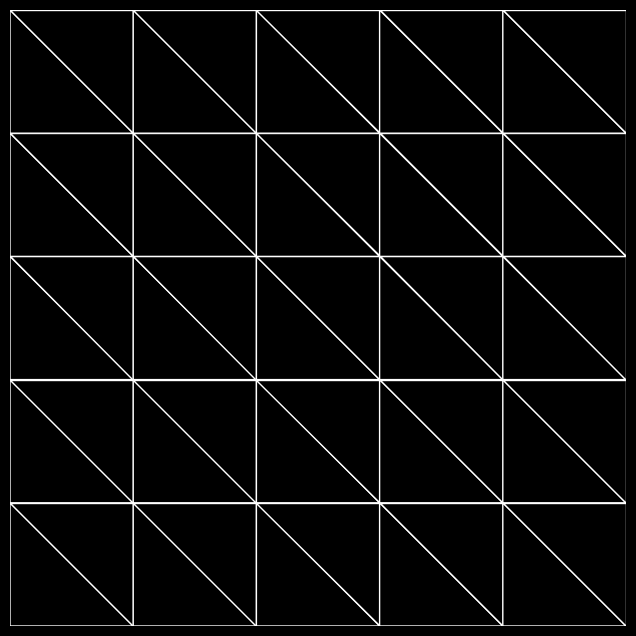
&\bullet\text{\textbf{\large {TEXCOORD0}}, litteraly specify a section of the Chip, in the gpu, that is going to be used as minimicrocomputers}\\
&\text{this is basically a section that runs the simulated pixels in the chip, so we can evaluate them. and operate them by}\\
&\text{launching a set instrution of instructions over them.}\\
&\bullet\text{\textbf{\large {POSITION}} and \textbf{\large {SV\_POSITION}}, is the same as the previous TEXCOORD0, but instead for vertexes, so it usually tents to }\\
&\text{be a small number of vertexes, but with new chips and new optimizations this number has also increase, we got to keep in }\\
&\text{mind that a section of our TEXCOORD0 is going to run on specifily sections of the vertexes which are usually triangles.}\\
&\text{keep in mind that the TEXCOORD0 information map to specific triangles. made out of the vertexes}\\
&\text{the reason why there are two different POSITION and SV\_POSITION, is cuz one is before translating them in the space}\\
&\text{ and the second one is after the vertexes were translated.}\\
&\text{}\\
\end{aligned}$$
    sampler2D _MainTex;
    float4 _MainTex_ST;
    int _SetScreen ;
    float _StepTime;
$$\begin{aligned}
&\bullet\text{\textbf{\large {sampler2D}} \_MainTex, there are going to be similar data structures, like this one but instead of thinking}\\
&\text{it as an array you should think of them as an image, that you could access if you iterate over the (x,y) axis,}\\
&\text{the reason why information is easy to store this way, is cuz remember that chips are basically cables and switches}\\
&\text{all miniaturize to the atom scale, so arrange things in lines is more difficult cuz phisically is harder to build }\\
&\text{is like a book, which thing is easier to handle, a single sheet of paper like a rool of paper,}\\
&\text{ or a notebook where you can swtich to each page depending which thing you need. cuz if it were the roll, the}\\
&\text{in order to read something in the middle of the roll thing you write either you need to unroll it or unroll it }\\
&\bullet\text{\textbf{\large {float4}}, this one is like a mini array of 4 items, that you can populate with floats, so prety easy.}\\
&\text{usually is used to represent or colors , RGBW, or position in space XYZW}\\
&\bullet\text{\textbf{\large {float}}, this is a basic float, really clear and straight}\\
&\bullet\text{\textbf{\large {int}}, this is a integer, normally running things in integer tents to be easier. when data operations are necessary.}\\
&\text{}\\
\end{aligned}$$
    PixelData vert (VertexInfo v)
    {
        PixelData o;
        o.vertex = UnityObjectToClipPos(v.vertex);
        o.uv = TRANSFORM_TEX(v.uv, _MainTex);
        return o;
    }
$$\begin{aligned}
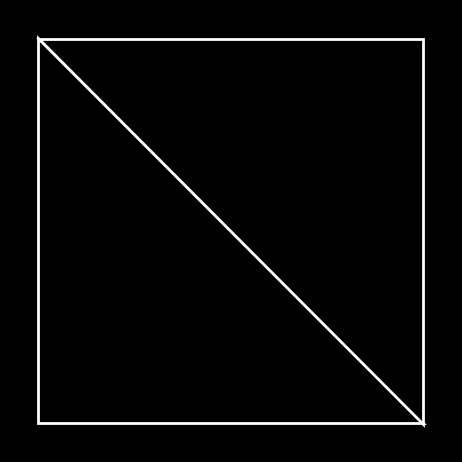
&\bullet\text{This function got for only purpose in this shader, is to populate the information in the chips, withe the position of }\\
&\text{the vertexes, in this case we are using a plane as our main shape our canvas where to position the vertexes, so imagine a }\\
&\text{ square build up by two triangles. or a square build up or draw up by rectangle triangles.}\\
&\text{}\\
\end{aligned}$$
    fixed4 frag (PixelData i) : SV_Target
    {
        // THIS CODE MEANS
        // HOW TO RUN THE PIXELS OF THE SCREEN.

        fixed4 colorWhite = float4(1,1,1,1); // Color white.
        fixed4 colorBlack = float4(0,0,0,1); // Color Black.
        float2 uv =  i.uv ;

        fixed4 col = fixed4(uv.x, uv.y , 0.0, 1.0);

        return col;

    }
$$\begin{aligned}
&\text{This function is the one where we are going spend a lot of time on , its because here is where the mathematics }\\
&\text{for each single mini computer happens, imagine that each single pixel got a computer on, and what you are going to do is }\\
&\text{use a computer over each pixel to modify it, what you are going to do is modify the pixel by doing different types of }\\
&\text{mathematical operations so all of the colors could change in tandem and in unisom in the way we want, }\\
&\text{that's exactly what we are doing, literally 3d is practically and illusion, that looks like there is something in depth}\\
&\text{when in reality is just colors being display in a very particular way, in unison, or unity? the way you want.}\\
&\bullet\text{\textbf{\large {SV\_Target}} what this means is like the vertexes flag that we use previously, is that this is }\\
&\text{ going to set things up for placing or position orders, but instead to set vertexes is going to set pixels.}\\
&\text{}\\
&\text{the pixels came from the structured that we set up at the beggining this structured is the one that is going to work}\\
&\text{as holder of the pixels, the way how the chip stored this information is on planes or more clearer, images or fields}\\
&\text{of transistors that are going to work as a coordinate system, (X,Y), where the information is going to be updated and }\\
&\text{retrived, so as its flag stated TEXCOORD0, it came in a coordinate system.}\\
&\text{so in the structured ~i~, and the subvariable uv, the pixels are abstracted.}\\
&\text{}\\
\end{aligned}$$
fixed4 frag (PixelData i) : SV_Target
$$\begin{aligned}
&\text{now is where all we been saying about mini computers, and computers inside computers start to get sense, the reason }\\
&\text{of this is cuz, the thing that we are going to operate from this moment on is the pixel, from the moment the function}\\
&\text{ "frag" start, the operation that we are going to process from this precise instant is on the pixel, we are going to make }\\
&\text{operations that are going to make the pixel change its colors in a way that is very particular, a very distinctive way }\\
&\text{to reorder the pixel in multiple ways. that it allow us to visualize things, represent things, organize details, but overall}\\
&\text{change its colors to make everything got sense, give sense to the pixel is what we are doing. direction, order, cohesion}\\
&\text{clarity, steps, ways, paths, to behave according the representations that we want to set up for it to follow. }\\
&\text{}\\
&\text{So when we evaluate like the did in \textbf{\large{float 2 uv}} is that we are getting litteraly is the coordinates of the pixel }\\
&\text{we are supposed to operate, the information that this variable contain is the coordinate of the pixel that we are going to modify}\\
&\text{normaly this coordinates that we it set up for default came from \textbf{\large{-1 to 0}} so if we output from the function }\\
&\text{as it detail on we must create a \textbf{\large{fixed4}} data type, that we could use to set the colors of the pixels, we could }\\
&\text{use float instead but for this example we are going to use the default, which is the fixed4, whom came with }\\
&\text{8-bit value ranging from -2 to 2, to output a color, and how we are going to populate the color with, easy we are going to set up }\\
&\text{the values of color, usualy this go, from 0 to 1, for each RGB, and W for the albedo or brightness normally. }\\
&\text{by using the coordinates from the TEXCOORD0, that came from 0 to 1 for all the position of the pixels in the coordinate system}\\
&\text{in the chip.}\\
\end{aligned}$$
float2 uv = i.uv ;
$$\begin{aligned}
&\text{So if we populate the color using this information \textbf{\large {fixed4(uv.x, uv.y, 0, 1.0)}}, we are going to notice}\\
&\text{that the elements from the bottom left are going to be black cuz the position they are representing is the (0,0) coordinate,}\\
&\text{but if instead by go to the x axis limit which would be the bottom right of the screen we are goinig to check that the }\\
&\text{color is going to be red cuz the position is going to be in the corodinate system (1,0) but if we go to the right up corner (1,1)}\\
&\text{we are going to check that if we mix two colors red and green we are going to get yellow which is the collor that's on the }\\
&\text{top right corner.}\\
\end{aligned}$$
fixed4 col = fixed4(uv.x, uv.y , 0.0, 1.0);

$$\begin{aligned}
&\text{if we instead make the output variable to (1,1,1,1) we are going to output the color white }\\
\end{aligned}$$
    fixed4 frag (PixelData i) : SV_Target
    {

        // THIS CODE MEANS
        // HOW TO RUN THE PIXELS OF THE SCREEN.

        fixed4 colorWhite = float4(1,1,1,1); // Color white.
        fixed4 colorBlack = float4(0,0,0,1); // Color Black.

        float2 uv =  i.uv ;


        fixed4 col = colorWhite;

        return col;

    }

$$\begin{aligned}
&\text{but if we change the color x variable for 1 we are going to make the output variable to (1,0,0,1)}\\
&\text{the output we expect in this case as the RGBW states, we spect a 100\% red as output }\\
\end{aligned}$$
fixed4 frag (PixelData i) : SV_Target
{

    // THIS CODE MEANS
    // HOW TO RUN THE PIXELS OF THE SCREEN.

    fixed4 colorWhite = float4(1,1,1,1); // Color white.
    fixed4 colorBlack = float4(0,0,0,1); // Color Black.
    fixed4 colorRed = float4(1,0,0,1); // Color Red.

    float2 uv =  i.uv ;


    fixed4 col = colorRed;

    return col;

}

Smoothstep
$$\LARGE\text{Smoothstep main Theory}$$
$$\begin{aligned}
&\text{the smooth step functions is a mathematical method, that is going to help us blend things into a more smoother data }\\
&\text{display of information, in this case we are talking about pixels, but the questions that you maybe are wondering }\\
&\text{is how this works, which are the things that this thing does that makes this thing to do that thing we . }\\
&\text{set up to do. }\\
&\text{lets brake it down in pieces. }\\
\end{aligned}$$
    float a = a;
    float b = b;
    float x = x;

    float d = smoothstep(a, b, x);
$$\begin{aligned}
&\text{this is how the smoothstep function look in code, provided by the shading language library. in this case is CG}\\
&\text{the standard for Unity, and also the previous version for HLSL, the DirectX shading language for Microsoft.}\\
&\text{}\\
&\text{The idea right now is to explain what is behind curtains that we could use to explain why the things happen}\\
&\text{the way they do.}\\
&\text{The question now, what's behind curtains? EASY like cutting butter, just and simple math}\\
\end{aligned}$$
$$\text{}$$
$$\text{this is the function represented in mathematical notation}$$
$$\text{smoothstep}(a, b, x) = S(a, b, x)$$
$$\\[5ex]$$
$$\text{This is the output we want to get from the function}$$
$$S( a, b, x) = S = 3t^2 - 2t^3$$
$$\\[5ex]$$
$$\text{remember that there are multiples ways to get this output our similar ones, not just this way}$$
$$\text{We are going to derive this polinomial function later}$$
$$\\[5ex]$$
$$\begin{aligned}
&\text{Now the question here is how we could define } \quad t \quad \text{ in such a way that fills the gaps for our }\\
&\text{function, the polimomial got as primary purpose to make a transition of data from one point to the other}\\
&\text{the idea, is to make information plot into this determined field, so we can transition}\\
&\text{between data as the name of the function state in a smoothly fashion, but how we can do such thing.}\\
&\text{The output is going to be the polinomial function solution for each t, but how we populate this function ?}\\
&\text{now how we could reorganize or reorder information from one size end to the other}\\
\end{aligned}$$
$$\\[5ex]$$
$$\begin{aligned}
&\text{that's what the clamp function is going to help us do, what we are going to do with the clamp function}\\
&\text{is limit the function bounds so each of the points on one end is map to the other end directly, which means}\\
&\text{that for a certain section of the\quad }\mathbb{R} \quad \text{numbers, we are going to map this section}\\
&\text{between the section } 0 - 1 \quad \text{of the} \quad \mathbb{R}\quad \text{numbers.}
\\[1.5em]
\end{aligned}$$
$$t = \left(\text{clamp}\left(\frac{x - a}{b - a},\quad 0,\quad 1\right)\right)$$
$$t = \text{max}\left(0, \quad\text{min}\left(1, \quad \frac{x - a}{b - a}\right)\right)$$
$$\begin{aligned}
\\[1.5em]
&\text{so lets define the first section as:} \\
&\bullet\quad 1\text{-}section = f \quad : \mathbb{R} \to [a, b]\\
&\text{And the second section as:}\\
&\bullet\quad 2\text{-}section = f \quad : \mathbb{R} \to [0, 1]
\\[1.5em]
&\text{So the idea here is to make a map from:}\\
&\text{}\quad \mathbb{R} \to [a, b] \implies \mathbb{R} \to [0, 1] \\
&\text{Or in other terms:}\\
&\quad 1\text{-}section: \mathbb{R} \to [a, b] \quad \implies \quad 2\text{-}section: \mathbb{R} \to [0, 1]
\end{aligned}$$
$$\begin{aligned}
\\[0.5em]
&\text{The way how we do the mapping, besides on the properties of division, which are }\\
&\text{How many times the denominator could fit in the numerator, how many denominators elements}\\
&\text{are necessary to make equality to the numerator}\\
\end{aligned}$$
$$\\[2.0em]$$
$$\frac{\text{Numerator}}{\text{Denominator}}$$
$$\\[2.0em]$$
$$\frac{x - a}{b - a}$$
$$\\[3.0em]$$
$$\text{Lets understand the first section of this division}\\$$
$${x - a}$$
$$\begin{aligned}
\\[0.5em]
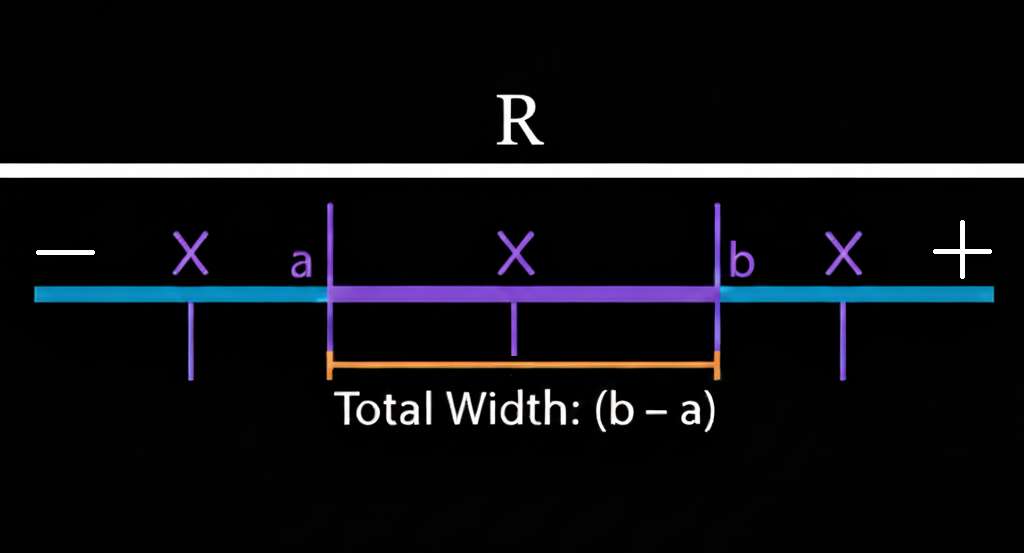
&\text{So how we could make interpretation or use of the division definition into the current formula, simple}\\
&\text{the process we are going to follow is pick the first section of the }\mathbb{R} \text{ that'll be the domain} \\
&\text{and identify if the point that we are evaluating is in the segment or not, and if yes, check how far}\\
&\text{is the point on the section from the beggining bound of the section.}\\
\end{aligned}$$
$$\begin{aligned}
&\text{So if the point } ''X'' \text{ from the real numbers } ''X'' \in \mathbb{R} \text{ is } \textbf{BEFORE}\text{ the } ''a'' \text{ bound, which means that}\\
\end{aligned}$$
$$X < a$$
$$ \text{So if we make a substraction}$$
$$ for \ all \quad x < a \implies (x - a) = \mathbb{R} < a = always\;in\ \mathbb{R}^-$$
$$\text{which means that the }"X"\text{ point is } \textbf{BEFORE}\text{ the } "a" \text{ bound}\\$$
$$\\[3.0em]$$
$$\begin{aligned}
&\text{So if the point } ''X'' \text{ from the real numbers } ''X'' \in \mathbb{R} \text{ is } \textbf{IN} \text{ the } ''a'' \text{ bound, means that}\\
\end{aligned}$$
$$X = a$$
$$ \text{So if we make a substraction}$$
$$ for \ all \quad x = a \implies (x - a) = 0 = always\;in\ 0$$
$$\text{which means that the }"X"\text{ point is exactly } \textbf{AT}\text{ the } "a" \text{ bound}\\$$
$$\\[3.0em]$$
$$\begin{aligned}
&\text{So if the point } ''X'' \text{ from the real numbers } ''X'' \in \mathbb{R} \text{ is } \textbf{AFTER} \text{ the } ''a'' \text{ bound, which means that}\\
\end{aligned}$$
$$X > a$$
$$ \text{So if we make a substraction}$$
$$ for \ all \quad x > a \implies (x - a) = \mathbb{R} > a = always\;in\ \mathbb{R}^+$$
$$\text{which means that the }"X"\text{ point is } \textbf{AFTER}\text{ the } "a" \text{ bound}\\$$
$$\\[3.0em]$$
$$\begin{aligned}
&\text{Rememeber that also this substraction represent the distance from } "X" \ to\ "a" \text{ independly of the sign} \\
\end{aligned}$$
$$\left| a - b \right| = \left| b - a \right|$$
$$\\[2.0em]$$
$$\\[3.0em]$$
$$\text{lets make and example about each situation:}\\$$
$$\\[3.0em]$$
$$\begin{aligned}
&\text{Given the bound } a = 10 \text{ and the point } x = 4: \\
&x < a \implies 4 < 10 \\
\\
&\textbf{1. Subtraction:} \\
&x - a = 4 - 10 = -6 \\
\\
&\textbf{2. Result:} \\
&-6 < 0 \implies (x - a) \in \mathbb{R}^- \\
\\
&\text{Let } a = 10 \text{ and } b = 4 \\
\\
&\textbf{Left Side: } |a - b| \\
&|10 - 4| = |6| = 6 \\
\\
&\textbf{Right Side: } |b - a| \\
&|4 - 10| = |-6| = 6 \\
\\
&\textbf{Conclusion:} \\
&|10 - 4| = |4 - 10| \implies 6 = 6 \\
\\
&\therefore \text{The point } x \text{ is confirmed to be \textbf{BEFORE} the bound } a.
\end{aligned}$$
$$\\[3.0em]$$
$$\begin{aligned}
&\text{Given the bound } a = 10 \text{ and the point } x = 10: \\
&x = a \implies 10 = 10 \\
\\
&\textbf{1. Subtraction:} \\
&x - a = 10 - 10 = 0 \\
\\
&\textbf{2. Result:} \\
&x - a = 0 \implies (x - a) \notin \mathbb{R}^+ \cup \mathbb{R}^- \\
\\
&\text{Let the bound } a = 10 \text{ and the point } b = 10 \\
\\
&\textbf{Left Side: } |a - b| \\
&|10 - 10| = |0| = 0 \\
\\
&\textbf{Right Side: } |b - a| \\
&|10 - 10| = |0| = 0 \\
\\
&\textbf{Conclusion:} \\
&|10 - 10| = |10 - 10| \implies 0 = 0
\\
&\therefore \text{The point } x \text{ is confirmed to be exactly \textbf{AT} the bound } a.
\end{aligned}$$
$$\\[3.0em]$$
$$\begin{aligned}
&\text{Given the bound } a = 10 \text{ and the point } x = 15: \\
&x > a \implies 15 > 10 \\
\\
&\textbf{1. Subtraction:} \\
&x - a = 15 - 10 = 5 \\
\\
&\textbf{2. Result:} \\
&5 > 0 \implies (x - a) \in \mathbb{R}^+ \\
\\
&\text{Let } a = 10 \text{ and } b = 15 \\
\\
&\textbf{Left Side: } |a - b| \\
&|10 - 15| = |-5| = 5 \\
\\
&\textbf{Right Side: } |b - a| \\
&|15 - 10| = |5| = 5 \\
\\
&\textbf{Conclusion:} \\
&|10 - 15| = |15 - 10| \implies 5 = 5
\\
&\therefore \text{The point } x \text{ is confirmed to be \textbf{AFTER} the bound } a.
\end{aligned}$$
$$\huge\boxed{x - a}$$
$$\\[4.0em]$$
$$\text{Now what we had define how the numerator of the division works, so lets break down the denominator }$$
$$\frac{x - a}{b - a} \implies \frac{\text{Numerator}}{\text{Denominator}}$$
$$\\[2.0em]$$
$$\begin{aligned}
&\text{What is in reality the operation that in the Denominator is really following, which is in reality the steps that }\\
&\text{this substraction is going to do to the entire formula, which are in reality the motions that are going to be }\\
&\text{modify in the entire of this equation ann in which way, which are the things that this operation is going to affect }\\
&\text{in the entire solution of this equation, how and why.}
&\\[2.0em]
\end{aligned}$$
$${b - a}$$
$$\\[2.0em]$$
$$\begin{aligned}
&\text{We got to define the bounds of the substraccion, so its basically as the previous substraction, but in this case }\\
&\text{is extremely necessary to define if the bounds are or } a < b \ or \ a > b \\
\end{aligned}$$
$$\begin{aligned}
&\text{if the bounds of the denominator are set to } a < b \\
&\text{then this operation is going to lets us now the distance from position } a \text{ to position } b \text{ in the }\mathbb{R} \\
&\text{ this result would always, ALWAYS + be positive } \\
&for all \ a < b \implies (b - a) \in \mathbb{R}^+ \\
\end{aligned}$$
$$\\[2.0em]$$
$$\begin{aligned}
&\text{if the bounds of the denominator are set to } a > b \\
&\text{then this operation is going to lets us now the distance from position } a \text{ to position } b \text{ in the }\mathbb{R} \\
&\text{ this result would always, ALWAYS - be negative } \\
&forall \ a > b \implies (b - a) \in \mathbb{R}^- \\
\end{aligned}$$
$$\\[2.0em]$$
$${b - a}$$
$$\\[2.0em]$$
$$\begin{aligned}
&\text{lets set an example right now as... } a < b \text{ ...so we could check exactly what is happening.} \\
&\text{ as we konw... }, |b - a|, \text{... if ...} a < b ,\ \text{ for each every substraction we are going to get a positive value } \\
&\text{ but the question here is what does this values represent in reality, which is the definition of this substraction, easy,} \\
&\text{ the line or bar, size that is going to be our ruler, the thing that allows us to measure things, the unit of measure. } \\
\end{aligned}$$
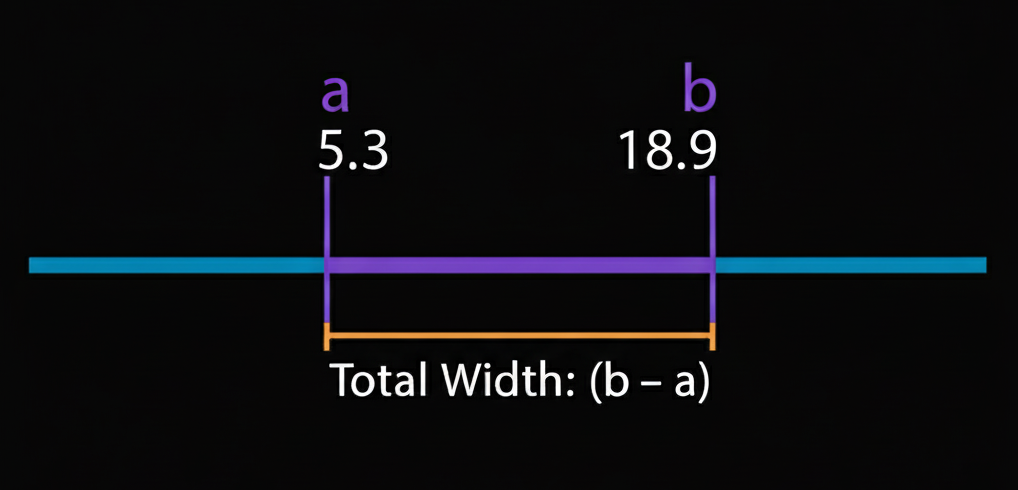
$$\begin{aligned}
&\text{ now you'll be wondering which is exactly the things that we are going to measure, which are the values that we are going to } \\
&\text{ measure, which are the ideas that we need to specify here, so we could understand how we could measure things with a value } \\
&\text{ the idea besides in the expression theory and concepts of DIVISIONS, so lets explain how this sitaution works. } \\
\end{aligned}$$
$${|x-a|}\\$$
$$\begin{aligned}
&\text{We already know that this expression is going to tell us how far is the }\ x \ \text{ from the }\ a \\
&\text{independly of the sign.} \\
\end{aligned}$$
$${x-a}\\$$
$$\begin{aligned}
&\text{and this expression is going to provide us with a sign, which is going to tell us if the... } x \text{ ...is before the... } a \\
&\text{or if the... } x \text{ ... is after the ... } a \text{ ... position on the line.} \\
&\text{if the substraction equals to 0, that means that the... } x \text{ ... is currently at the same spot or position as... } a \\
\end{aligned}$$
$$\begin{aligned}
&\text{ and we also know that the difference between... } b - a \text{ ... when... } b > a \text{ ... would always be positive }\\
&\text{ and the value that this operation is equal is the distance from... } a \text{ ...to... } b \\
\end{aligned}$$
$$\begin{aligned}
&\text{So once we had define how the first distance is measure, and we are able to identify on which position of the line the... } x \\
&\text{is located, then the question that rise up is how we could use this information, what can we do to make this information }\\
&\text{useful, well now the idea is to make use of the information that we just define into something useful.}\\
&\text{and usefulness, only appear when we are answering questions, so which is the question here that we want to answer.}\\
&\text{the questions here and the theorem that we want to prove is the next one}\\
\end{aligned}$$
$$\\[5ex]$$
$$\large\textbf{how many } \boldsymbol{(b - a)} \textbf{ are in } \boldsymbol{(x - a)} \textbf{ ? }$$
$$\\[5ex]$$
$$\large\boldsymbol{\frac{x - a}{b - a}} = \boldsymbol{\dfrac{\textbf{line to measure}}{\textbf{ruler}}}$$
$$\\[5ex]$$
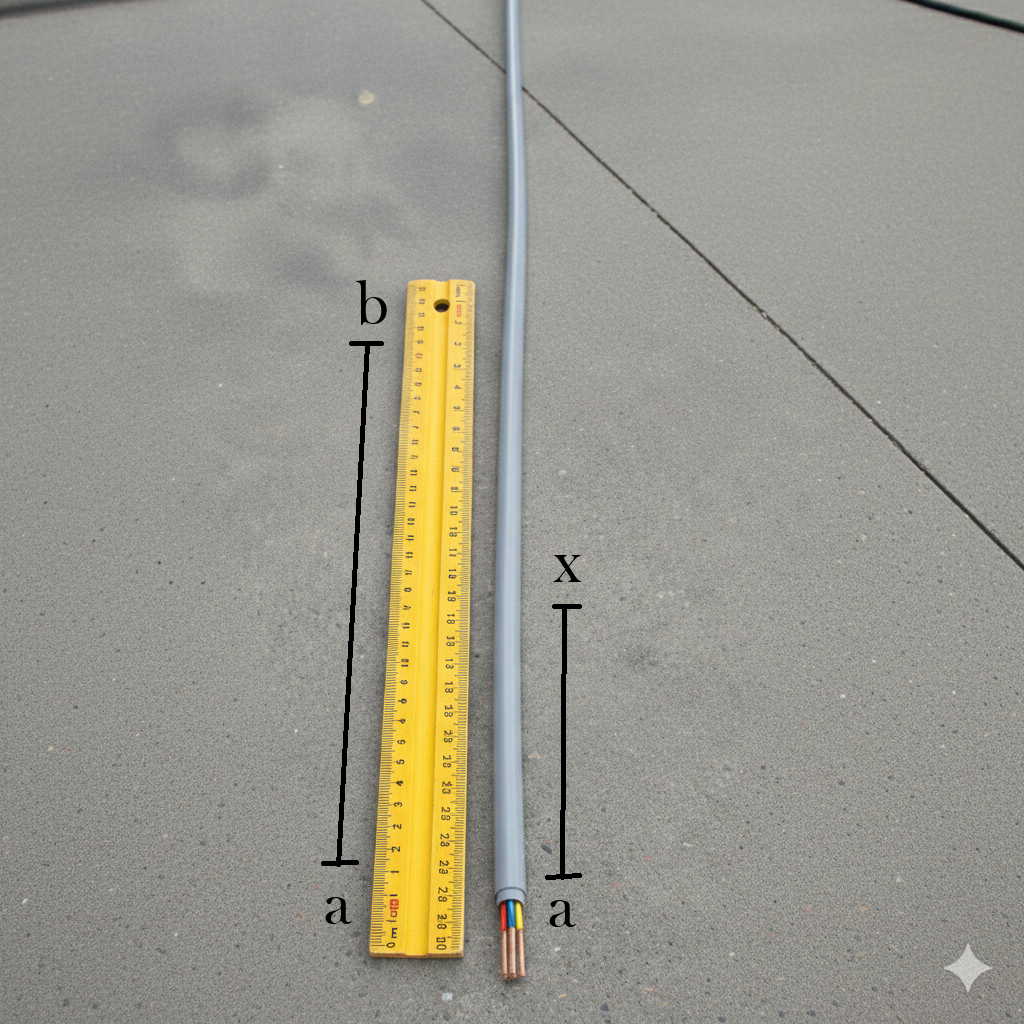
$$\begin{aligned}
&\text{so now that we are able to measure how many denominators are in the numerator, then we need to "clamp" }\\
&\text{which are going to help us identify or determine which values of... } x - a \text{ ... are going to be useful for us}\\
&\text{in this case we are going to set the values between... } 0 \ \& \ 1 \text{ ...which are going to represent the values within the }\\
&\text{range of... } b - a \text{ ... which is the unit of measure that is going to help us map the values of... } x \text{ ...to the }\\
&\text{range of... } 0 \ \& \ 1 \\
&\text{remember that witin the } \mathbb{R} \text{ numbers, exist an infinite number of items, that we are going to use to map from one }\\
&\text{representation to the other, or you could also say from one line space to the other line space.}\\
\end{aligned}$$
$$\begin{aligned}
&\text{Given: } x = 2, \ a = 10, \ b = 30 \\
\\
&\textbf{Step 1: Calculate the Numerator (Line to measure)} \\
&x - a = 2 - 10 = -8 \\
\\
&\textbf{Step 2: Calculate the Denominator (Ruler)} \\
&b - a = 30 - 10 = 20 \\
\\
&\textbf{Step 3: Form the Fraction} \\
&\frac{x - a}{b - a} = \frac{-8}{20} = -0.4 \\
\\
&\therefore \text{The result is negative because the point } x \text{ is outside the bound to the left.}
\\[5ex]
&\text{Given: } a = 10, \ b = 30, \ x = 10 \\
\\
&\text{Condition: } x = a \implies 10 = 10 \\
\\
&\textbf{1. Calculate the Numerator (Line to measure)} \\
&x - a = 10 - 10 = 0 \\
\\
&\textbf{2. Calculate the Denominator (Ruler)} \\
&b - a = 30 - 10 = 20 \\
\\
&\textbf{3. Form the Fraction} \\
&\frac{x - a}{b - a} = \frac{0}{20} = 0 \\
\\
&\therefore \text{The result is exactly \textbf{0} because the point } x \text{ is at the start of the ruler.}
\\[5ex]
&\text{Given: } a = 10, \ b = 30, \ x = 25 \\
\\
&\text{Condition: } a < x < b \quad (10 < 25 < 30) \\
\\
&\textbf{1. Calculate the Numerator (Line to measure)} \\
&x - a = 25 - 10 = 15 \\
\\
&\textbf{2. Calculate the Denominator (Ruler)} \\
&b - a = 30 - 10 = 20 \\
\\
&\textbf{3. Form the Fraction} \\
&\frac{x - a}{b - a} = \frac{15}{20} = 0.75 \\
\\
&\therefore \text{The result is a positive decimal } (0.75) \text{ because the point } x \text{ is \textbf{AFTER} } a \text{ but \textbf{WITHIN} the ruler.}
\\[5ex]
&\text{Given: } a = 10, \ b = 30, \ x = 40 \\
\\
&\text{Condition: } x > b \implies 40 > 30 \\
\\
&\textbf{1. Calculate the Numerator (Line to measure)} \\
&x - a = 40 - 10 = 30 \\
\\
&\textbf{2. Calculate the Denominator (Ruler)} \\
&b - a = 30 - 10 = 20 \\
\\
&\textbf{3. Form the Fraction} \\
&\frac{x - a}{b - a} = \frac{30}{20} = 1.5 \\
\\
&\therefore \text{The result is \textbf{1.5}} \text{ because the point } x \text{ has exceeded the ruler by } 50\%.
\end{aligned}$$
$$\\[5ex]$$
$$\begin{aligned}
&\text{Now the next thing would be add the clamp function which is nothing else but a way to set up the bounds from } \\
&\text{where we want to number line to be usefull } \\
&\text{so this is a simple comparation between which is the maximum and which is the minimum between the result of } \\
&\text{the division and the bounds that we are going to set.}\\
\end{aligned}$$
$$\\[5ex]$$
$$ruler = \frac{x - a}{b - a}$$
$$\\[5ex]$$
$$t = \max(0, \min(1, \ ruler))$$
$$\begin{aligned}
&\text{If we take the max and the min in order to clamp the bounds we are going to get this function } \\
&\text{but how we derive this function is a set of procedures that we could understand by identifying } \\
&\text{properties of polinomials. } \\
\end{aligned}$$
$$\\[5ex]$$
$$\\[5ex]$$
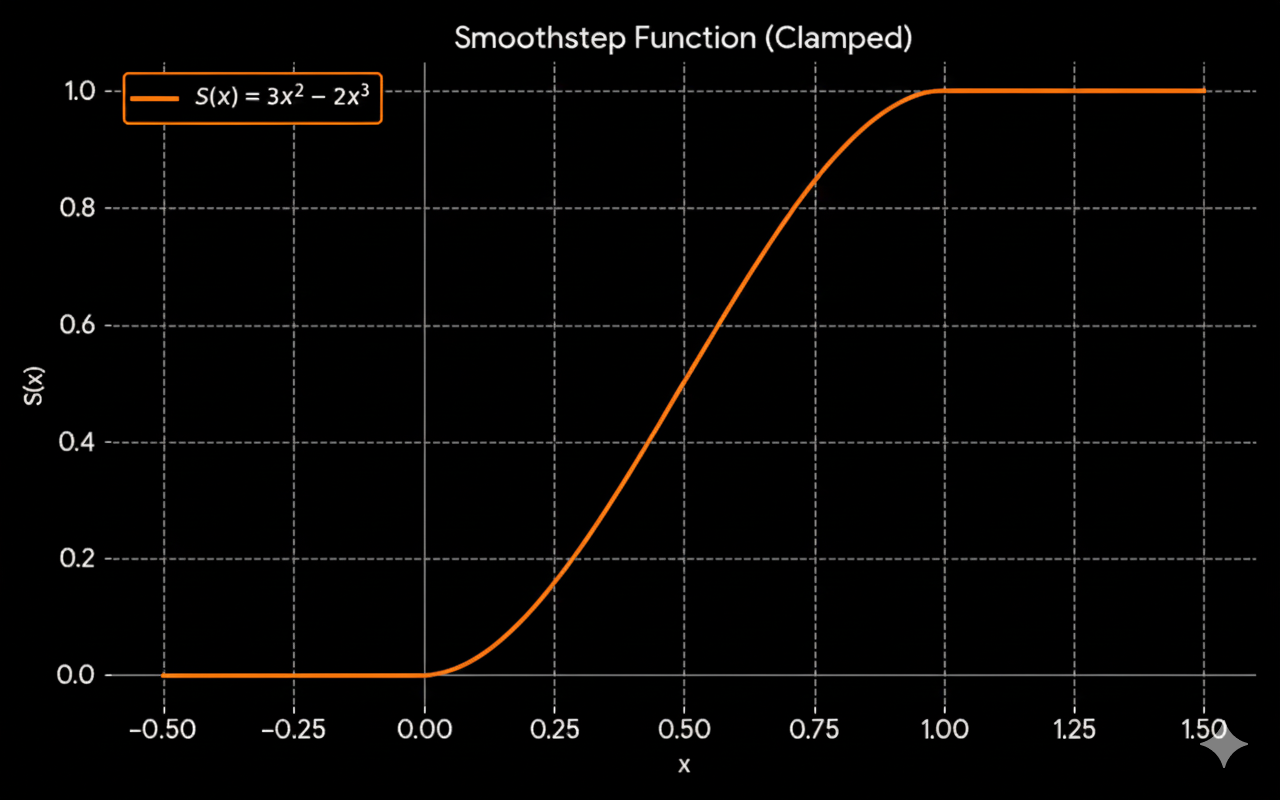
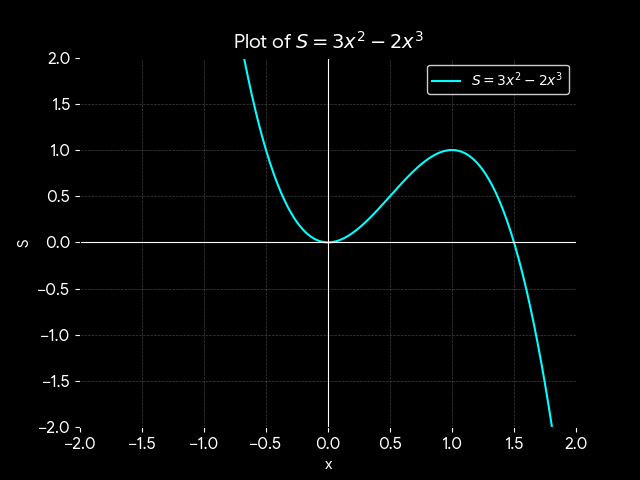
$$\text{smoothstep}(a, b, x) = S(a, b, x) = S = 3t^2 - 2t^3$$
$$\\[5ex]$$
$$\\[5ex]$$
$$\begin{aligned}
&\text{Now the only thing that miss is how to derive the cubic polinomial, which is understand from which place}\\
&\text{this formula came from.}\\
\end{aligned}$$
$$\begin{aligned}
&\textbf{1. The Constraints} \\
&\text{To derive the Smoothstep function for the interval } t \in [0,1], \\
&\text{we define four boundary conditions:} \\
\\
&\begin{aligned}
&\text{Start Position:} & S(0) &= 0 \\
&\text{End Position:} & S(1) &= 1 \\
&\text{Start Velocity:} & S'(0) &= 0 \\
&\text{End Velocity:} & S'(1) &= 0
\end{aligned} \\
\\
&\textbf{2. The Cubic Derivation} \\
&\text{We begin with a general cubic polynomial:} \\
&S(t) = at^3 + bt^2 + ct + d \\
\\
&\text{First, we find its derivative:} \\
&S'(t) = 3at^2 + 2bt + c \\
\\
&\text{Applying the initial constraints } (t=0): \\
&S(0) = a(0)^3 + b(0)^2 + c(0) + d = 0 \implies d = 0 \\
&S'(0) = 3a(0)^2 + 2b(0) + c = 0 \implies c = 0 \\
\\
&\text{Applying the boundary constraints } (t=1): \\
&S(1) = a(1)^3 + b(1)^2 = 1 \implies a + b = 1 \\
&S'(1) = 3a(1)^2 + 2b(1) = 0 \implies 3a + 2b = 0 \\
\\
&\textbf{3. Solving the System} \\
&\text{From the velocity equation:} \\
&2b = -3a \implies b = -1.5a \\
\\
&\text{Substituting } b \text{ into the position equation:} \\
&a + (-1.5a) = 1 \\
&-0.5a = 1 \implies a = -2 \\
\\
&\text{Solving for } b: \\
&b = -1.5(-2) \implies b = 3 \\
\\
&\textbf{4. Final Result} \\
&\text{Plugging the constants back into the original polynomial, we arrive at:} \\
&S(t) = 3t^2 - 2t^3
\end{aligned}$$
$$\\[15ex]$$
$$\begin{aligned}
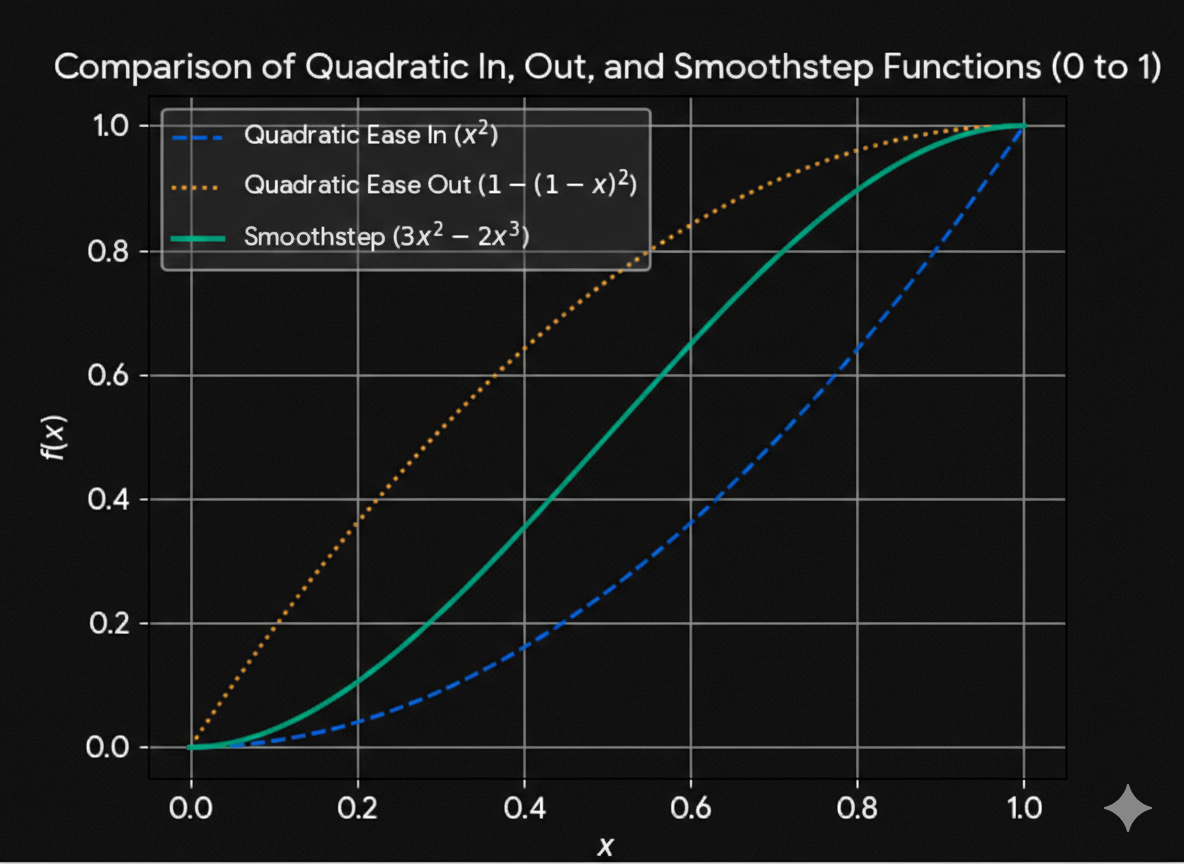
&\text{Other way to derive this function is by lerping between two specific functions.} \\
\end{aligned}$$
$$a = t^2 \quad (Ease\ In)$$
$$b = 2t - t^2 \quad (Ease\ Out)$$
$$\\[5ex]$$
$$\text{lerp}(a, b, t) = a + t(b - a)$$
$$\\[5ex]$$
$$S(t) = \underbrace{t^2}_{a} + t(\underbrace{(2t - t^2)}_{b} - \underbrace{t^2}_{a})$$
$$\\[5ex]$$
$$S(t) = t^2 + t((2t - t^2) - t^2)$$
$$\\[5ex]$$
$$S(t) = t^2 + t(2t - 2t^2)$$
$$\\[5ex]$$
$$S(t) = t^2 + 2t^2 - 2t^3$$
$$\\[5ex]$$
$$S(t) = 3t^2 - 2t^3$$
$$\\[5ex]$$
Circle
$$\LARGE\text{Draw Cicle main Theory}$$
$$\begin{aligned}
&\text{The things that we need to set from this moment on is how to place more mathematics in this field, }\\
&\text{cuz otherwise would be modified modify each single pixel by hand, and that is basically painting and drawing,}\\
&\text{and we are neither painting or drawing sooooo.., what?}\\
&\text{the way to make everything work here, is by making math happen, and the best way to make }\\
&\text{something like that happen, is by specifying equations and detail more functions that we could use to }\\
&\text{create more exemplifications of the goals that we had set }\\
\end{aligned}$$
$$\begin{aligned}
&\text{the function that we are going to run a lot, and the one that we are going to use really much is going }\\
&\text{to be the frag functions the reason why is cuz we are currenctly operating on the plane,}\\
&\text{or more specific on a plane, and our plan is to do such thing.}\\
&\text{till we get a really good understanding of how signals work, and how we can make use of them, }\\
&\text{we need to understand how we can make use of the signals and the best place to do such thing is the PLANE! }\\
\end{aligned}$$
$$\begin{aligned}
&\text{Now lets draw the easiest thing you could paint on a shader, like the easiest thing to imagine, }\\
&\text{lets draw a CIRCLE!!!}\\
&\text{So how we are going to do that, simple lets define what a circle really is, }\\
&\text{lets begin by understandingwhat defines a circle}\\
&\\[2ex]
\end{aligned}$$
$$\begin{aligned}
&\LARGE\textbf{Circle:}\\
&\text{A circle in theory are all the points where their distance to the center of the circle is less or equal than the radius }\\
\end{aligned}$$
$$\\[5ex]\\$$
$$\mathcal{C} = \{ (x, y) \in \mathbb{R}^2 \mid \sqrt{(x - h)^2 + (y - k)^2} \leq r \}$$
$$\\[5ex]\\$$
$$\begin{aligned}
&\text{Center Coordinates:}\quad (h, k) \\
&\text{Arbitrary Point:}\quad (x, y) \\
&\text{Radius:}\quad r \\
\\
&\textbf{The Distance Formula} \\
&d = \sqrt{(x - h)^2 + (y - k)^2} \\
\\
&\textbf{The Geometric Constraint} \\
&d \leq r \implies \sqrt{(x - h)^2 + (y - k)^2} \leq r\\
\\
&\text{Which is the same thing as this:} \\
&(x - h)^2 + (y - k)^2 \leq r^2\\
\\
&\text{If the center is the origin:} \\
&(h, k) = (0, 0) \\
&\text{Then}:
\\[0.8em]
&(x - 0)^2 + (y - 0)^2 \leq r^2\\
\\
&x^2 + y^2 \leq r^2\\
\end{aligned}$$
fixed4 frag (PixelData i) : SV_Target
{

    // THIS CODE MEANS
    // HOW TO RUN THE PIXELS OF THE SCREEN.

    fixed4 colorWhite = float4(1,1,1,1); // Color white.
    fixed4 colorBlack = float4(0,0,0,1); // Color Black.

    float4 col = colorBlack;
    float2 uv =  i.uv;
	float2 coor = (uv * 2.0)  - 1.0;

    float2 center = float2(0.0, 0.0);

    float radius = 0.5;

    float2 coor2 = coor - center;

    if(length(coor2) <= radius)
    {
        col.x = 1.0;
    }

    col = fixed4(col.x, 0.0 , 0.0, 1.0);

    return col;
}
$$\begin{aligned}
&\text{Lets set the color to the background to pure black}\\
\end{aligned}$$
float4 col = colorBlack;
$$\begin{aligned}
&\text{So lets explain the things that are happening here, which are the steps that we are following through this code.}\\
&\text{step by step we are going to understand how mathematics and computing are being evaluated}\\
\end{aligned}$$
$$\begin{aligned}
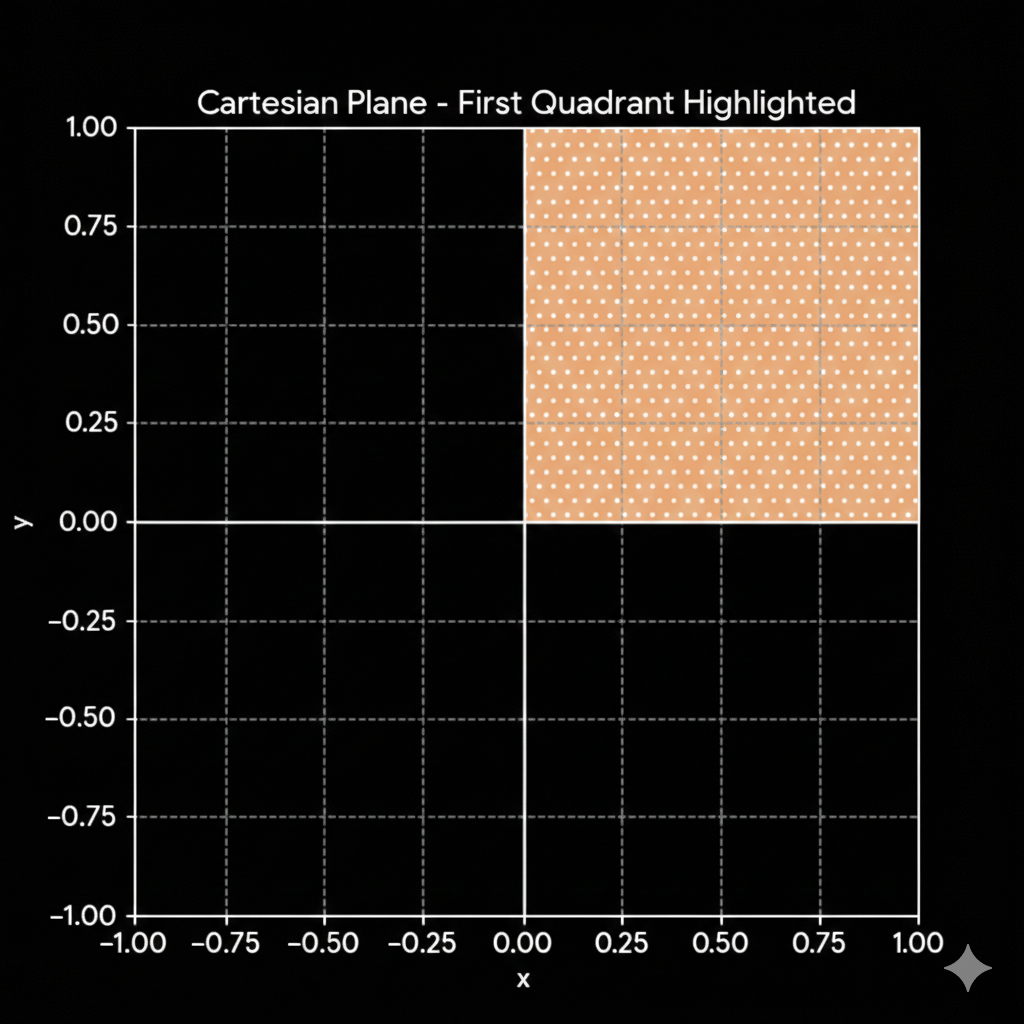
&\text{the } \textbf{uv} \text{ states for all the points on the plane on } (x,y) \text{ representation}\\
&\text{but remember that this first } \mathbf{i.uv} \text{ is set up predetermine to the first cuadrant of }\\
&\text{the cartesian plane }\\
\end{aligned}$$
    float2 uv =  i.uv;
    float2 coordinateScale = (uv * 2.0) ;
$$\begin{aligned}
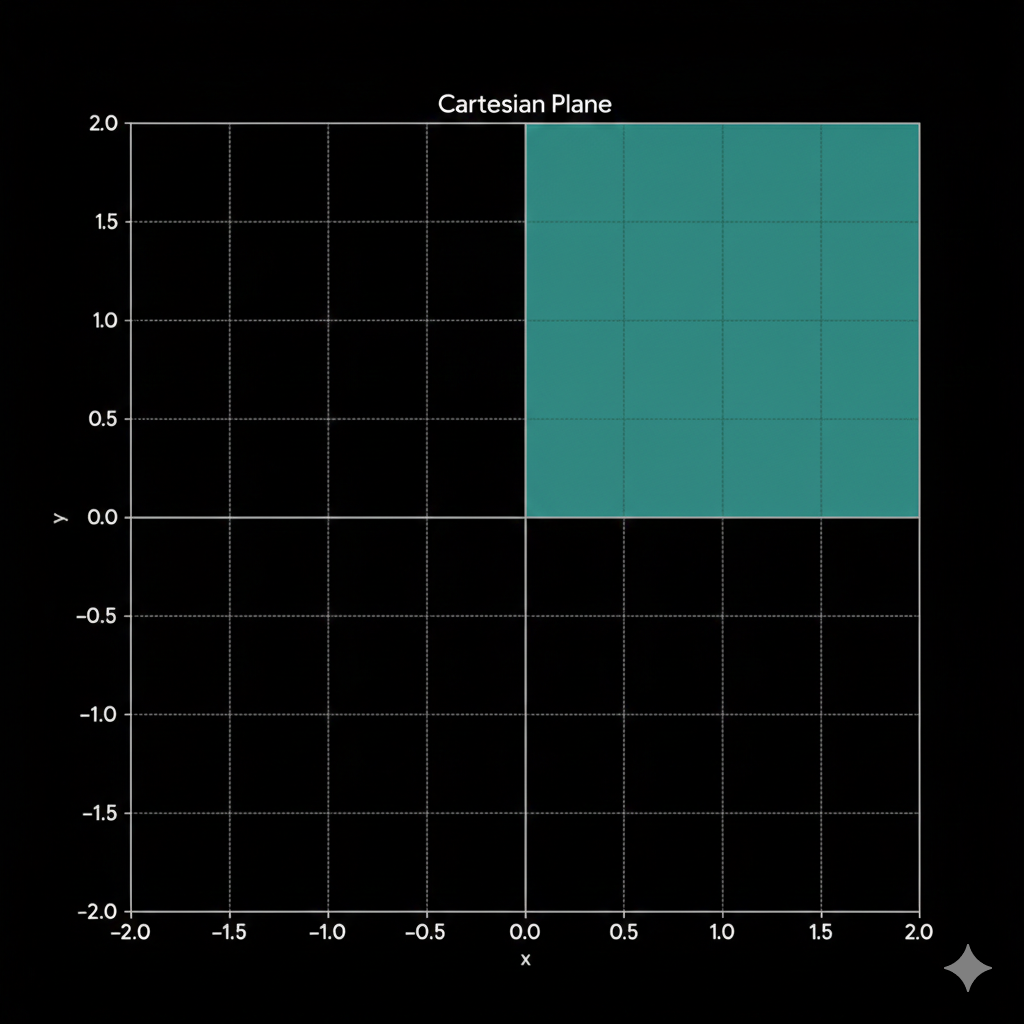
&\text{when we multiply by 2, what we are really doing is extending the dimension of the points that we are }\\
&\text{going to fit into this plane, so instead of fitting from}\ 0\ to\ 1\ \text{we are setting up use from }\\
&0\ to\ 2\\
&\text{}\\
\end{aligned}$$
$$\begin{aligned}
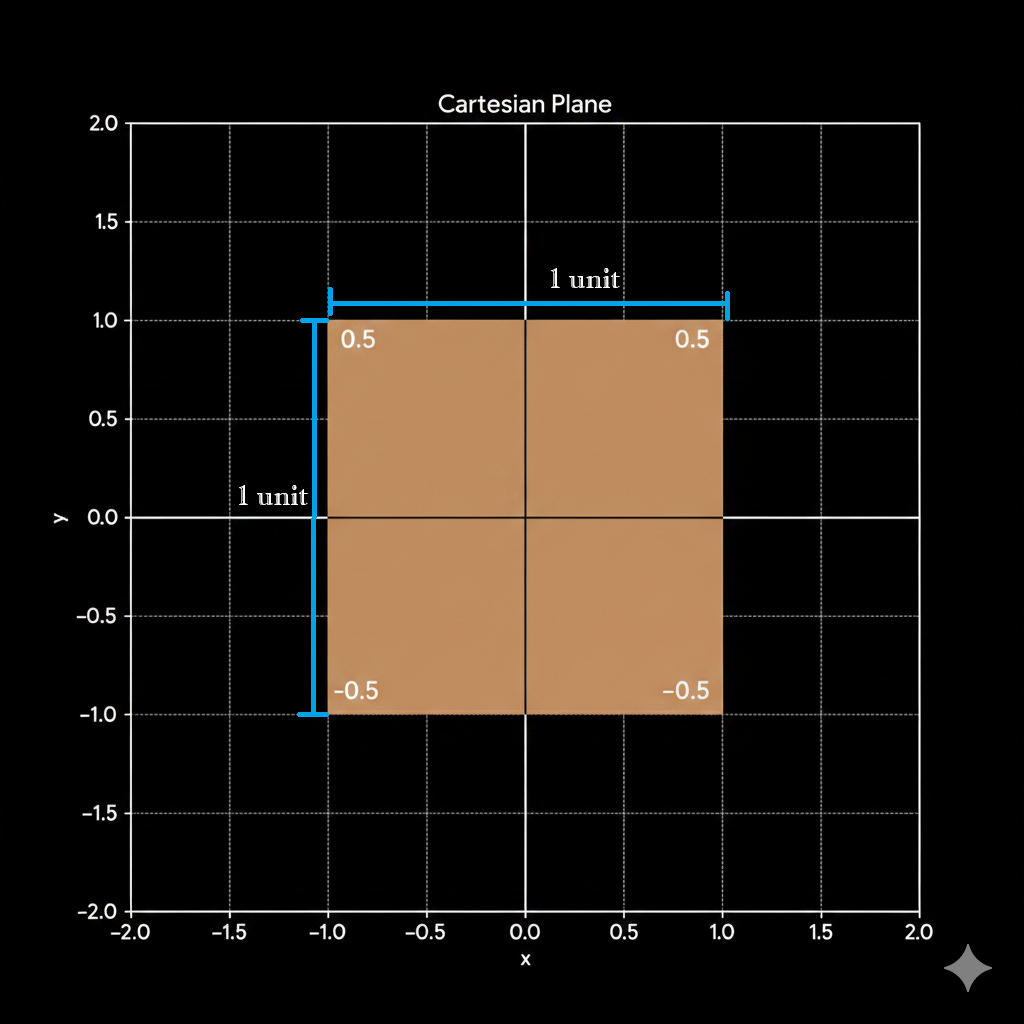
&\text{Now the that we had extend the size of the plane or more specifly the first cuadrant of the cartesian plane}\\
&\text{what we are going to do is center the origin in the middle of the plane, and to do such thing we just need}\\
&\text{to substract } -1.0 \text{ to the entire set of points so we end up with a general cartesian plane, on our} \\
&\text{PLANE!, that we could use to plot functions and geometric things.}\\
\end{aligned}$$
float2 coordinateScale = (uv * 2.0) - 1.0;
$$\begin{aligned}
&\text{now what we are currently seeing in the plane is the yellowrange part of the previous cartesian plane this is }\\
&\text{the current plane we are seeing, on our screen, the yellow part would be the define space where we are going to }\\
&\text{output things on.}\\
&\text{}\\
\end{aligned}$$
float2 center = float2(0.0, 0.0);
$$\begin{aligned}
&\text{Now define the center of the circle that's going to be where the circle would be position, }\\
&\text{in this case the origin, so that means that our circle is position at: } \\
\\
&\mathcal{C} = (x, y) = (0, 0) \\
\\
&\mathcal{C}\; \xmapsto{\text{means}} \text{stands for the position of the circle }\\
&\text{}\\
\end{aligned}$$
float radius = 0.5;
$$\large r \implies \text{radius}$$
$$\begin{aligned}
&\text{Now in order to continue with the theory of the circle lets define the radius, which in this case is also}\\
&\text{the same as the max distance from the center of the circle, so every point with distance to the center }\\
&\text{less than the radius would represent that is part of the circle.}\\
\end{aligned}$$
$$\textbf{The Geometric Constraint} \\$$
$$d \leq r \implies \sqrt{(x - h)^2 + (y - k)^2} \leq r\\$$
$$\\[7ex]\\$$
$$\begin{aligned}
&\text{some other way to specify in code the substractions inside the root as the following}\\
\end{aligned}$$
$$ float2\; coor2 = float2((x - h)\ ,\ (y - k))$$
float2 coor2 = coor - center;
$$coor2\; =\; \mathbf{C_2}\ =\ \mathbf{P} - \mathbf{C}\ =\ \begin{pmatrix} x - h \\ y - k \end{pmatrix}$$
$$\\[5ex]\\$$
$$coor2\; =\;(x - h, y - k)\ =\ (x, y) - (h, k)$$
$$\\[5ex]\\$$
$$coor2\; =\;\mathbf{C_2}\ =\ \mathbf{P} - \mathbf{C} $$
if(length(coor2) <= radius)
{
    col.x = 1.0;
}
$$\begin{aligned}
&\text{The operation that we are going to do now would be evaluate the points so they fulfill }\\
&\text{the condition, and if the point fulfill then is when we are going to know that the point must }\\
&\text{be colored, the condition in general mathematics terms is the next one:}\\
\end{aligned}$$
$$d \implies length(coor2) $$
$$\\[4ex]\\$$
$$\textbf{The Distance Formula} \\$$
$$d = \sqrt{(x - h)^2 + (y - k)^2} \\$$
$$\\[4ex]\\$$
$$d \leq r \implies \sqrt{(x - h)^2 + (y - k)^2}\; \leq\; r\\$$
$$\\[4ex]\\$$
$$d \leq r \implies \sqrt{\mathbf{(C_2)^2}}\; \leq\; r \ =\ \sqrt{\mathbf{P^2} - \mathbf{C^2}}\; \leq\; r $$
$$\\[4ex]\\$$
$$\begin{aligned}
&\text{So if the condition of the previous statement is meet then the output would be this colored red }\\
\end{aligned}$$
    col = fixed4(col.x, 0.0 , 0.0, 1.0);

    return col;

End
Mathematics-Code_INDEX