Matemathics Explanations of Eulers Identity

Math Explanation CODE relations

From Andraelity, how CODE using math.

In thy following lines we are going to verify or create the connexion that would allow us to unite code with mathematics

EULERS IDENTITY We are going to detail information and ideas that could help us clarify from which place all this properties came from in a more cohesive and organized way to validate that every single proof that we set is presented in an order that could help us understand the reasons of equality that could elevate in the future to a order of probabilities, the orders we are structuring right now are base entirely on very well define amounts, that we could follow in a relationship of quantity, a quantity of numbers that we could start to count, and keep counting till we are able to reason about more inmense and overlimited set of items.

Index Webpages Redirect

Eulers Identity


Factorial Operator


$$n! = n \times (n-1) \times (n-2) \times \dots \times 3 \times 2 \times 1$$

Factorial Calculation Result
4! 4×3×2×1 24
3! 24/4 6
2! 6/3 2
1! 2/2 1
0! 1/1 1

The next formula describe the behavior and the proof of the factorial operator
n ! = ( n + 1 ) ! n + 1

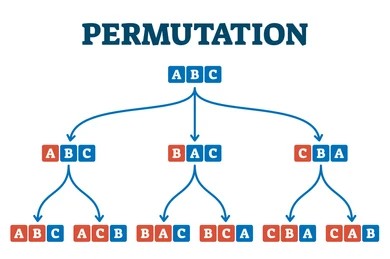
Permutational Formula


How many different ways can I pick a group of k items from a total set of n items,

if the order matters?
P ( n , k ) = n ! ( n k ) !
P ( 10 , 3 ) = 10 ! ( 10 3 ) ! = 10 ! 7 ! = 10 × 9 × 8 × 7 × 6 × = 10 × 9 × 8 = 720

P(n,k) = n! (n-k)! P(3,2) = 3! (3-2)! = 3! 1! = 3×2×1 1 = 6


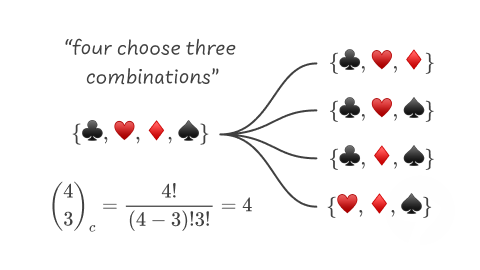
Binomial Coefficient / Combinations Formula / "n choose k"


How many different ways can I pick a group of k items from a total set of n items,

if the order doesn't matter?
C ( n , k ) = ( n k ) = n ! k ! ( n k ) !
( 5 3 ) = 5 ! 3 ! ( 5 3 ) ! = 120 6 × 2 = 10


Binomial Theorem


( a + b ) n = k = 0 n ( n k ) a n k b k
Example #1,
( x + 2 ) 4

( x + 2 ) 4 = ( x + 2 ) ( x + 2 ) ( x + 2 ) ( x + 2 )
( x + 2 ) 4 = ( x 2 + 4 x + 4 ) ( x 2 + 4 x + 4 )
( x + 2 ) 4 = x 4 + ( 4 x 3 + 4 x 3 ) + ( 4 x 2 + 16 x 2 + 4 x 2 ) + ( 16 x + 16 x ) + 16
( x + 2 ) 4 = x 4 + 8 x 3 + 24 x 2 + 32 x + 16

( x + 2 ) 4 = k = 0 4 ( 4 k ) ( x ) 4 k ( 2 ) k
1 ( x 4 ) ( 2 0 ) = 1 x 4 1 = x 4 4 ( x 3 ) ( 2 1 ) = 4 x 3 2 = 8 x 3 6 ( x 2 ) ( 2 2 ) = 6 x 2 4 = 24 x 2 4 ( x 1 ) ( 2 3 ) = 4 x 8 = 32 x 1 ( x 0 ) ( 2 4 ) = 1 1 16 = 16
( x + 2 ) 4 = x 4 + 8 x 3 + 24 x 2 + 32 x + 16

Example #2,
( 2 x 3 y ) 3

( 2 x 3 y ) 3 = ( 2 x 3 y ) ( 2 x 3 y ) ( 2 x 3 y )
( 2 x 3 y ) ( 2 x 3 y ) = 4 x 2 12 x y + 9 y 2
( 2 x 3 y ) 3 = ( 4 x 2 12 x y + 9 y 2 ) ( 2 x 3 y )
( 2 x 3 y ) 3 = 8 x 3 36 x 2 y + 54 x y 2 27 y 3

( a b ) n = k = 0 n ( n k ) a n k ( b ) k = k = 0 n ( 1 ) k ( n k ) a n k b k

( 2 x 3 y ) 3 = k = 0 3 ( 1 ) k ( 3 k ) ( 2 x ) 3 k ( 3 y ) k

1 ( 2 x ) 3 ( 3 y ) 0 = 1 ( 8 x 3 ) ( 1 ) = 8 x 3

3 ( 2 x ) 2 ( 3 y ) 1 = 3 ( 4 x 2 ) ( 3 y ) = 36 x 2 y

3 ( 2 x ) 1 ( 3 y ) 2 = 3 ( 2 x ) ( 9 y 2 ) = 54 x y 2

1 ( 2 x ) 0 ( 3 y ) 3 = 1 ( 1 ) ( 27 y 3 ) = 27 y 3
( 2 x 3 y ) 3 = 8 x 3 36 x 2 y + 54 x y 2 27 y 3

Euler's Number Existence


First proof of obtention
e = ( 1 + 1 n ) n
e = lim n ( 1 + 1 n ) n
e = ( 1 + 1 10 ) 10 = k = 0 10 ( 10 k ) ( 1 10 ) k

= ( 10 0 ) ( 1 10 ) 0 + ( 10 1 ) ( 1 10 ) 1 + ( 10 2 ) ( 1 10 ) 2 + ( 10 3 ) ( 1 10 ) 3 + ( 10 4 ) ( 1 10 ) 4

+ ( 10 5 ) ( 1 10 ) 5 + ( 10 6 ) ( 1 10 ) 6 + ( 10 7 ) ( 1 10 ) 7 + ( 10 8 ) ( 1 10 ) 8 + ( 10 9 ) ( 1 10 ) 9 + ( 10 10 ) ( 1 10 ) 10
e = ( 1 + 1 10 ) 10 = 1 + 10 10 + 45 100 + 120 1000 + 210 10000 + 252 100000
+ 210 1000000 + 120 10000000 + 45 100000000 + 10 1000000000 + 1 10000000000 2.59374

Target Accuracy Required Value of n Resulting Value
1 Decimal Place (2.7) n = 14 2.701
2 Decimal Places (2.71) n = 135 2.710
3 Decimal Places (2.718) n = 1,354 2.717
4 Decimal Places (2.7182) n = 13,534 2.7181


Second proof of obtention

( a + b ) n = ( 1 + 1 n ) n = k = 0 n ( n k ) a n k b k = ( n 0 ) ( 1 ) n ( 1 n ) 0 + ( n 1 ) ( 1 ) n 1 ( 1 n ) 1 + ( n 2 ) ( 1 ) n 2 ( 1 n ) 2 +

if  k = 0 ,  Binomial Theorem  

( n 0 ) ( 1 ) n ( 1 n ) 0 = n ! 0 ! ( n 0 ) ! ( 1 ) n ( 1 n ) 0
$$\text{Total} = \frac{\color{red}{\cancel{n!}}}{1 \cdot \color{red}{\cancel{n!}}} \cdot (1)^n \cdot \left( \frac{1}{n} \right)^0 = 1 \cdot 1 \cdot 1 = 1 $$


if  k = 1 ,  Binomial Theorem  
( n 1 ) ( 1 ) n 1 ( 1 n ) 1 = n ! 1 ! ( n 1 ) ! ( 1 ) n 1 ( 1 n ) 1
$$\text{Total} = \left( \frac{n \cdot (n - 1)!}{1 \cdot (n - 1)!} \right) \cdot (1)^{n - 1} \cdot \left(\frac{1}{n}\right)^1 $$ $$\\[5ex]$$ $$\text{Total} =\left( \frac{\color{blue}{\cancel{n}} \cdot \color{red}{\cancel{(n - 1)!}}}{1 \cdot \color{red}{\cancel{(n - 1)!}}} \right) \cdot (1)^{n - 1} \cdot \left(\frac{1}{\color{blue}{\cancel{n}}}\right)^1 = 1$$


if  k = 2 ,  Binomial Theorem  
$$ \binom{n}{2} (1)^{n-2} \left(\frac{1}{n}\right)^2 = \left( \frac{n!}{2!(n-2)!} \right) \cdot (1)^{n-2} \cdot \left( \frac{1}{n} \right)^2$$ $$\\[5ex]$$ $$\text{Total} = \left( \frac{n!}{2!(n-2)!} \right) \cdot (1)^{n-2} \cdot \left( \frac{1}{n} \right)^2 = \frac{n(n-1)(n-2)!}{2 \cdot (n-2)!} \cdot 1 \cdot \frac{1}{n^2} $$ $$\\[5ex]$$ $$\text{Total} = \frac{\color{blue}{\cancel{n}}\color{white}{(n-1)}\color{red}{\cancel{(n-2)!}}} {2 \cdot \color{red}{\cancel{(n-2)!}}} \cdot 1 \cdot \frac{1}{ n \cdot \color{blue}{\cancel{n}} }$$ $$\\[5ex]$$ $$\text{Total} = \frac{n-1}{2} \cdot 1 \cdot \frac{1}{n}$$ $$\\[5ex]$$ $$\text{Total} = \frac{n-1}{2n}$$


if  k = 3 ,  Binomial Theorem  
$$\binom{n}{3} (1)^{n-3} \left(\frac{1}{n}\right)^3 = \left( \frac{n!}{3!(n-3)!} \right) \cdot (1)^{n-3} \cdot \left( \frac{1}{n} \right)^3$$ $$\\[5ex]$$ $$\text{Total} =\left( \frac{n!}{3!(n-3)!} \right) \cdot (1)^{n-3} \cdot \left( \frac{1}{n} \right)^3 = \frac{n(n-1)(n-2)(n-3)!}{6 \cdot (n-3)!} \cdot (1)^{n-3} \cdot \frac{1}{n \cdot n^2}$$ $$\\[5ex]$$ $$\text{Total} = \frac{\color{blue}{\cancel{n}}\color{white}{(n-1)(n-2)}\color{red}{\cancel{(n-3)!}}}{6 \cdot \color{red}{\cancel{(n-3)!}}} \cdot \color{white}{(1)^{n-3}} \cdot \frac{1}{\color{blue}{\cancel{n}}\color{white}{\cdot n^2}}$$ $$\\[5ex]$$ $$\text{Total} = \frac{(n-1)(n-2)}{6} \cdot 1 \cdot \frac{1}{n^2}$$ $$\\[5ex]$$ $$\text{Total} = \frac{(n-1)(n-2)}{6n^2}$$


if  k = k ,  Binomial Theorem  
$$\\[5ex]$$ $$\binom{n}{k} (1)^{n-k} \left(\frac{1}{n}\right)^k = \left( \frac{n!}{k!(n-k)!} \right) \cdot (1)^{n-k} \cdot \left( \frac{1}{n} \right)^k$$ $$\\[5ex]$$ $$\text{Total} = \frac{n(n-1)(n-2)\cdots(n-(k-1))(n-k)!}{k! \cdot (n-k)!} \cdot (1)^{n-k} \cdot \frac{1}{n \cdot n^{k-1}}$$ $$\\[5ex]$$ $$\text{Total} = \frac{\color{blue}{\cancel{n}}\color{white}{(n-1)(n-2)\cdots(n-(k-1))}\color{red}{\cancel{(n-k)!}}}{\color{white}{k!} \cdot \color{red}{\cancel{(n-k)!}}} \cdot \color{white}{1} \cdot \frac{1}{\color{blue}{\cancel{n}}\color{white}{\cdot n^{k-1}}}$$ $$\\[5ex]$$ $$\text{Total} = \frac{(n-1)(n-2)\cdots(n-(k-1))}{k!} \cdot 1 \cdot \frac{1}{n^{k-1}}$$ $$\\[5ex]$$ $$\text{Total} = \frac{n-1}{n} \cdot \frac{n-2}{n} \dots \frac{n-(k-1)}{n} \cdot \frac{1}{k!}$$ $$\\[5ex]$$ $$\text{Total} = \left(1 - \frac{1}{n}\right) \cdot \left(1 - \frac{2}{n}\right) \dots \left(1 - \frac{k-1}{n}\right) \cdot \frac{1}{k!}$$ $$\\[5ex]$$
 General Expression for Binomial  
$$\\[5ex]$$ $$ e = \lim_{n \to \infty} \left( 1 + \frac{1}{n} \right)^n$$ $$\\[5ex]$$ $$(a + b)^n = \left( 1 + \frac{1}{n} \right)^n = \sum_{k=0}^{n} \binom{n}{k} a^{n-k} b^k = \sum_{k=0}^{n} \left(1 - \frac{1}{n}\right) \cdot \left(1 - \frac{2}{n}\right) \dots \left(1 - \frac{k-1}{n}\right) \cdot \frac{1}{k!}$$ $$\\[5ex]$$ $$\lim_{n \to \infty} \left( 1 + \frac{1}{n} \right)^n = \lim_{n \to \infty} \sum_{k=0}^{n} \left(1 - \frac{1}{n}\right) \cdot \left(1 - \frac{2}{n}\right) \dots \left(1 - \frac{k-1}{n}\right) \cdot \frac{1}{k!}$$ $$\\[5ex]$$ $$\lim_{n \to \infty} \left( 1 + \frac{1}{n} \right)^n = \sum_{k=0}^{n} \lim_{n \to \infty} \left(1 - \frac{1}{n}\right) \cdot \left(1 - \frac{2}{n}\right) \dots \left(1 - \frac{k-1}{n}\right) \cdot \frac{1}{k!}$$ $$\\[5ex]$$ $$\lim_{n \to \infty} \left( 1 + \frac{1}{n} \right)^n = \sum_{k=0}^{n} (1 - 0) \cdot (1 - 0) \dots (1 - 0) \cdot \frac{1}{k!}$$ $$\\[5ex]$$ $$\lim_{n \to \infty} \left( 1 + \frac{1}{n} \right)^n = \sum_{k=0}^{n} 1 \cdot 1 \dots 1 \cdot \frac{1}{k!} = \sum_{k=0}^{n} \frac{1}{k!}$$ $$\\[5ex]$$ $$ e = \lim_{n \to \infty} \left( 1 + \frac{1}{n} \right)^n = \sum_{k=0}^{n} \frac{1}{k!}$$

e = n = 0 1 n ! = 1 0 ! + 1 1 ! + 1 2 ! + 1 3 ! +

Terms (n) Calculation Sum (e ≈) Accuracy
1 term 1 1.0 Off by 63%
2 terms 1+1 2.0 Off by 26%
3 terms 2+0.5 2.5 Off by 8%
4 terms 2.5+0.1666... 2.6666... Off by 1.9%
7 terms +1/720 2.71805... 99.99% accurate
10 terms +1/362,880 2.7182815... 6 decimal places
13 terms +1/479,001,600 2.718281828... 10 decimal places


Third proof of obtention

if      n > 0

and if      a 0 = 1

and if      a n = a n 1 n

e = a 0 + n = 0 a 0 + n n + 1

Term ( an ) Contribution Accuracy Margin ( an-1 n ) Running Total
a0 1 Undefined 1.0
a1 1 a01 2.0
a2 0.5 a12 2.5
a3 0.166666 a23 2.666666
a4 0.041666 a34 2.708333
a5 0.008333 a45 2.716666
a6 0.001388 a56 2.718055
a7 0.000198 a67 2.718253
a8 0.000024 a78 2.718278
a9 0.000002 a89 2.718281


Euler's Power to X


e x = n = 0 x n n ! = 1 + x + x 2 2 ! + x 3 3 ! +

e 4 = n = 0 4 n n ! = 1 + 4 + 4 2 2 ! + 4 3 3 ! + 54.5981500331

e 4 54.5981500331

Term (n) Value of Term ( 4n n! ) Value of Term % of Total Accuracy Running Total
0 1 1.83% 1.8% 1
1 4 7.33% 9.2% 5
2 8 14.65% 23.8% 13
3 10.667 19.54% 43.3% 23.667
4 10.667 19.54% 62.9% 34.333
5 8.533 15.63% 78.5% 42.867
6 5.689 10.42% 88.9% 48.556
7 3.251 5.95% 94.9% 51.806
8 1.625 2.98% 97.9% 53.432
9 0.722 1.32% 99.2% 54.154
15 0.00045 0.0008% 99.99% 54.598


Imaginary Number i


$$i = \sqrt{-1} \quad \text{or} \quad i^2 = -1$$ $$\\[5ex]$$ $$i^1 = \mathbf{i}$$ $$\\[5ex]$$ $$i^2 = \mathbf{-1}$$ $$\\[5ex]$$ $$i^3 = -i$$ $$\\[5ex]$$ $$i^4 = \mathbf{1}$$ $$\\[5ex]$$ $$i^5 = i \text{(The cycle starts over!)}$$ $$\\[5ex]$$

Sine and Cosine


$$\\[5ex]$$ $$\text{if Point } A = (x,y) = (1,0), \text{ then } \cos(A) = 1 \\[2ex]$$ $$\\[5ex]$$ $$\text{if Point } A = (x,y) = (1,0), \text{ then } \sin(A) = 0 \\[2ex]$$ $$\\[5ex]$$ $$\text{if Point } B = (x,y) = (0,1), \text{ then } \sin(B) = 1 \\[2ex]$$ $$\\[5ex]$$ $$\text{if Point } B = (x,y) = (0,1), \text{ then } \cos(B) = 0 \\[2ex]$$ $$\\[5ex]$$


$$\\[5ex]$$ $$\text{If } \theta = 45^\circ = \frac{\pi}{4},\hspace{5pt} C = (0.707106811865, 0.707106811865)$$ $$\\[3ex]$$ $$\text{If } C = (0.707106811865, 0.707106811865),\hspace{5pt} C, sin = C.y = 0.707106811865$$ $$\\[3ex]$$ $$\text{If } C = (0.707106811865, 0.707106811865),\hspace{5pt} C, \cos = C.x = 0.707106811865$$ $$\\[5ex]$$ $$\text{If } \theta = 45^\circ = \frac{\pi}{4} ,\hspace{5pt} \sin(\theta) = 0.707106811865$$ $$\\[5ex]$$ $$\text{If } \theta = 45^\circ = \frac{\pi}{4},\hspace{5pt} \cos(\theta) = 0.707106811865$$ $$\\[5ex]$$ $$|\vec{C}| = \sqrt{x^2 + y^2}$$ $$\\[3ex]$$ $$\text{hipotenuse} = \hspace{3pt} h \hspace{3pt} = \sqrt{\text{base}^2 + \text{height}^2} \implies |\vec{C}| = \sqrt{x^2 + y^2}$$ $$\\[5ex]$$ $$|\vec{C}| = \sqrt{x^2 + y^2} = \hspace{3pt} 1 \hspace{3pt} = \sqrt{(\cos 45^\circ)^2 + (\sin 45^\circ)^2} = \sqrt{\left(\cos \left(\frac{\pi}{4}\right)\right)^2 + \left(\sin \left(\frac{\pi}{4}\right)\right)^2}$$


MORE PROOFS AND CLARIFICATION


Derivative


$$\text{General Formula for Derivative}$$ $$\\[5ex]$$ $$\large\boxed{f'(x) = \lim_{h \to 0} \frac{f(x + h) - f(x)}{h}}$$ $$\\[5ex]$$ $$\large \text{Example \#1}$$ $$\\[5ex]$$ $$\large \boxed {\quad f(x) = x^2 \quad}$$ $$\\[5ex]$$ $$f(x+h) = (x+h)^2$$ $$\\[5ex]$$ $$f'(x) = \lim_{h \to 0} \frac{(x+h)^2 - x^2}{h}$$ $$\\[5ex]$$ $$(x+h)^2 = x^2 + 2xh + h^2$$ $$\\[5ex]$$ $$f'(x) = \lim_{h \to 0} \frac{\color{red}{\cancel{x^2}} \color{white}{+ 2xh + h^2} \color{red}{\cancel{- x^2}}}{h}$$ $$\\[5ex]$$ $$f'(x) = \lim_{h \to 0} \frac{2xh + h^2}{h}$$ $$\\[5ex]$$ $$f'(x) = \lim_{h \to 0} \frac{\color{red}{\cancel{h}} \color{white}{(2x + h)}}{\color{red}{\cancel{h}}}$$ $$\\[5ex]$$ $$f'(x) = \lim_{h \to 0} (2x + h)$$ $$\\[5ex]$$ $$f'(x) = 2x + 0$$ $$\\[5ex]$$ $$\large \boxed {\quad f'(x) = 2x \quad}$$ $$\\[5ex]$$
$$\large \text{Theorem \#1 }$$ $$\\[5ex]$$ $$\large \boxed {\quad f(x) = x^n \quad}$$ $$\\[5ex]$$ $$f(x) = x^n \implies f'(x) = nx^{n-1}$$ $$\\[5ex]$$ $$f'(x) = \lim_{h \to 0} \frac{f(x + h) - f(x)}{h}$$ $$\\[5ex]$$ $$f'(x) = \lim_{h \to 0} \frac{(x + h)^n - x^n}{h}$$ $$\\[5ex]$$ $$\text{Binomial Theorem}$$ $$(x + h)^n = x^n + nx^{n-1}h + \frac{n(n-1)}{2}x^{n-2}h^2 + \dots + h^n$$ $$\\[5ex]$$ $$f'(x) = \lim_{h \to 0} \frac{\left( \color{red}{\cancel{x^n}} \color{white}{+ nx^{n-1}h + \frac{n(n-1)}{2}x^{n-2}h^2 + \dots + h^n} \right) \color{red}{\cancel{- x^n}}}{h}$$ $$\\[5ex]$$ $$f'(x) = \lim_{h \to 0} \frac{nx^{n-1}h + \frac{n(n-1)}{2}x^{n-2}h^2 + \dots + h^n}{h}$$ $$\\[5ex]$$ $$f'(x) = \lim_{h \to 0} \frac{h \left( nx^{n-1} + \frac{n(n-1)}{2}x^{n-2}h + \dots + h^{n-1} \right)}{h}$$ $$\\[5ex]$$ $$f'(x) = \lim_{h \to 0} \frac{\color{red}{\cancel{h}} \color{white}{\left( nx^{n-1} + \frac{n(n-1)}{2}x^{n-2}h + \dots + h^{n-1} \right)}}{\color{red}{\cancel{h}}}$$ $$\\[5ex]$$ $$f'(x) = \lim_{h \to 0} \left( nx^{n-1} + \frac{n(n-1)}{2}x^{n-2}h + \dots + h^{n-1} \right)$$ $$\\[5ex]$$ $$f'(x) = nx^{n-1} + 0 + 0 + \dots + 0$$ $$\\[5ex]$$ $$\large \boxed {\quad f'(x) = nx^{n-1}\quad}$$ $$\\[5ex]$$

MORE PROOFS AND CLARIFICATION


Taylor Series

$$\text{General Formula for Taylor Series}$$ $$\\[5ex]$$ $$\large\boxed{f(x) = \sum_{n=0}^{\infty} \frac{f^{(n)}(a)}{n!}(x-a)^n}$$ $$\\[5ex]$$ $$\text{where } a \in \mathbb{R} \text{ is the center point}$$ $$\\[5ex]$$ $$\circ \quad \text{Find } c_0$$ $$f(x) = c_0 + c_1(x-a) + c_2(x-a)^2 + c_3(x-a)^3 + \dots$$ $$\\[5ex]$$ $$\text{if } x = a \implies x - a = 0$$ $$\\[5ex]$$ $$f(x) = c_0 + c_1(0) + c_2(0)^2 + c_3(0)^3 + \dots$$ $$\\[5ex]$$ $$f(x) = c_0$$ $$\\[5ex]$$ $$c_0 = f(a)$$ $$\\[5ex]$$ $$\circ \quad \text{Find } c_1$$ $$\\[5ex]$$ $$f'(x) = 0 + c_1 + 2c_2(x-a) + 3c_3(x-a)^2 + \dots$$ $$\\[5ex]$$ $$\text{if } x = a \implies x - a = 0$$ $$\\[5ex]$$ $$f'(a) = 0 + c_1 + 2c_2(0) + 3c_3(0)^2 + \dots$$ $$\\[5ex]$$ $$f'(a) = c_1 + 0 + 0 \dots$$ $$\\[5ex]$$ $$f'(a) = c_1 $$ $$\\[5ex]$$ $$c_1 = f'(a)$$ $$\\[5ex]$$ $$\circ \quad \text{Find } c_2$$ $$\\[5ex]$$ $$f''(x) = 2c_2 + 6c_3(x-a) + 12c_4(x-a)^2 + 20c_5(x-a)^3 + 30c_6(x-a)^4 + \dots$$ $$\\[5ex]$$ $$\text{if } x = a \implies x - a = 0$$ $$\\[5ex]$$ $$f''(a) = 2c_2 + 6c_3(0) + 12c_4(0)^2 + 20c_5(0)^3 + 30c_6(0)^4 + \dots$$ $$\\[5ex]$$ $$f''(a) = 2c_2 $$ $$\\[5ex]$$ $$c_2 = \frac{f''(a)}{2}\quad\mid \quad\frac{f''(a)}{2!}$$ $$\\[5ex]$$ $$f^{(n)}(a) = n! \cdot c_n$$ $$\\[5ex]$$ $$\text{So... } $$ $$\\[5ex]$$ $$f^{(n)}(a) = n! \cdot c_n$$ $$\\[5ex]$$ $$c_n = \frac{f^{(n)}(a)}{n!}$$ $$\\[10ex]$$ $$\large \text{Example \#1}$$ $$\\[5ex]$$ $$\text{if } f(x) = e^x $$ $$\\[5ex]$$ $$f(x) = \sum_{n=0}^{\infty} \frac{f^{(n)}(a)}{n!}(x-a)^n \implies e^x = \sum_{n=0}^{\infty} \frac{e^a}{n!}(x-a)^n$$ $$\\[5ex]$$ $$\text{if, \quad } a = 0 $$ $$\\[5ex]$$ $$e^x = \sum_{n=0}^{\infty} \frac{e^a}{n!}(x)^n$$ $$\\[5ex]$$ $$f(x) = f(a) + f'(a)(x-a) + \frac{f''(a)}{2!}(x-a)^2 + \frac{f'''(a)}{3!}(x-a)^3 + \dots$$ $$\\[5ex]$$ $$e^x = e^a + e^a(x-a) + \frac{e^a}{2!}(x-a)^2 + \frac{e^a}{3!}(x-a)^3 + \frac{e^a}{4!}(x-a)^4 + \dots$$ $$\\[5ex]$$ $$a=0,\quad then \quad e^a = e^0 = 1$$ $$\\[5ex]$$ $$e^x = 1 + (x-0) + \frac{1}{2!}(x-0)^2 + \frac{1}{3!}(x-0)^3 + \frac{1}{4!}(x-0)^4 + \dots$$ $$\\[5ex]$$ $$\large e^x = 1 + x + \frac{x^2}{2!} + \frac{x^3}{3!} + \frac{x^4}{4!} + \dots$$ $$\\[5ex]$$ $$\large \boxed{e^x = \sum_{n=0}^{\infty} \frac{x^n}{n!} = 1 + x + \frac{x^2}{2!} + \frac{x^3}{3!} + \dots}$$ $$\\[10ex]$$ $$\large \text{Example \#2}$$ $$\\[5ex]$$ $$\text{if } f(x) = \cos(x) $$ $$\\[5ex]$$ $$f(x) = \sum_{n=0}^{\infty} \frac{f^{(n)}(a)}{n!}(x-a)^n \implies \cos(x) = \sum_{n=0}^{\infty} \frac{\frac{d^n}{dx^n}[\cos(x)]_{}}{n!}(x-a)^n$$ $$\\[5ex]$$ $$\text{if, \quad } a = 0 $$ $$\\[5ex]$$ $$\cos(x) = \sum_{n=0}^{\infty} \frac{\frac{d^n}{dx^n}[\cos(x)]_{}}{n!}(x)^n$$ $$\\[5ex]$$ $$f(x) = f(a) + f'(a)(x-a) + \frac{f''(a)}{2!}(x-a)^2 + \frac{f'''(a)}{3!}(x-a)^3 + \dots$$ $$\\[5ex]$$ $$\begin{aligned} f(a) &= \cos(a) \\ f'(a) &= -\sin(a) \\ f''(a) &= -\cos(a) \\ f'''(a) &= \sin(a) \\ f^{(4)}(a) &= \cos(a) \end{aligned}$$ $$\\[5ex]$$ $$\cos(x) = \cos(a) - \sin(a)(x-a) - \frac{\cos(a)}{2!}(x-a)^2 + \frac{\sin(a)}{3!}(x-a)^3 + \frac{\cos(a)}{4!}(x-a)^4 - \dots$$ $$\\[5ex]$$ $$\begin{aligned} f(0) = \cos(0) &= 1 \\ f'(0) = -\sin(0) &= 0 \\ f''(0) = -\cos(0) &= -1 \\ f'''(0) = \sin(0) &= 0 \\ f^{(4)}(0) = \cos(0) &= 1 \end{aligned}$$ $$\\[5ex]$$ $$\cos(x) = \cos(0) - \sin(0)(x) - \frac{\cos(0)}{2!}x^2 + \frac{\sin(0)}{3!}x^3 + \frac{\cos(0)}{4!}x^4 - \dots$$ $$\\[5ex]$$ $$\cos(x) = 1 - (0)x - \frac{1}{2!}x^2 + \frac{0}{3!}x^3 + \frac{1}{4!}x^4 - \dots$$ $$\\[5ex]$$ $$\large\boxed{\cos(x) = 1 - \frac{x^2}{2!} + \frac{x^4}{4!} - \frac{x^6}{6!} + \frac{x^8}{8!} - \dots}$$ $$\\[15 ex]$$ $$\large \text{Example \#3}$$ $$\\[5ex]$$ $$\text{if } f(x) = \sin(x) $$ $$\\[5ex]$$ $$\\[5ex]$$ $$f(x) = \sum_{n=0}^{\infty} \frac{f^{(n)}(a)}{n!}(x-a)^n \implies \sin(x) = \sum_{n=0}^{\infty} \frac{\frac{d^n}{dx^n}[\sin(x)]_{}}{n!}(x-a)^n$$ $$\\[5ex]$$ $$\text{if, \quad } a = 0 $$ $$\\[5ex]$$ $$\sin(x) = \sum_{n=0}^{\infty} \frac{\frac{d^n}{dx^n}[\sin(x)]_{}}{n!}(x)^n$$ $$\\[5ex]$$ $$f(x) = f(a) + f'(a)(x-a) + \frac{f''(a)}{2!}(x-a)^2 + \frac{f'''(a)}{3!}(x-a)^3 + \dots$$ $$\\[5ex]$$ $$\begin{aligned} f(a) &= \sin(a) \\ f'(a) &= \cos(a) \\ f''(a) &= -\sin(a) \\ f'''(a) &= -\cos(a) \\ f^{(4)}(a) &= \sin(a) \end{aligned}$$ $$\\[5ex]$$ $$\sin(x) = \sin(a) + \cos(a)(x-a) - \frac{\sin(a)}{2!}(x-a)^2 - \frac{\cos(a)}{3!}(x-a)^3 + \frac{\sin(a)}{4!}(x-a)^4 + \dots$$ $$\\[5ex]$$ $$\begin{aligned} f(0) = \sin(0) &= 0 \\ f'(0) = \cos(0) &= 1 \\ f''(0) = -\sin(0) &= 0 \\ f'''(0) = -\cos(0) &= -1 \\ f^{(4)}(0) = \sin(0) &= 0 \end{aligned}$$ $$\\[5ex]$$ $$\sin(x) = \sin(0) + \cos(0)(x) - \frac{\sin(0)}{2!}x^2 - \frac{\cos(0)}{3!}x^3 + \frac{\sin(0)}{4!}x^4 + \dots$$$$\\[5ex]$$$$\sin(x) = 0 + (1)x - \frac{0}{2!}x^2 - \frac{1}{3!}x^3 + \frac{0}{4!}x^4 + \frac{1}{5!}x^5 - \dots$$$$\\[5ex]$$$$\large\boxed{\sin(x) = x - \frac{x^3}{3!} + \frac{x^5}{5!} - \frac{x^7}{7!} + \frac{x^9}{9!} - \dots}$$


Eulers Identity

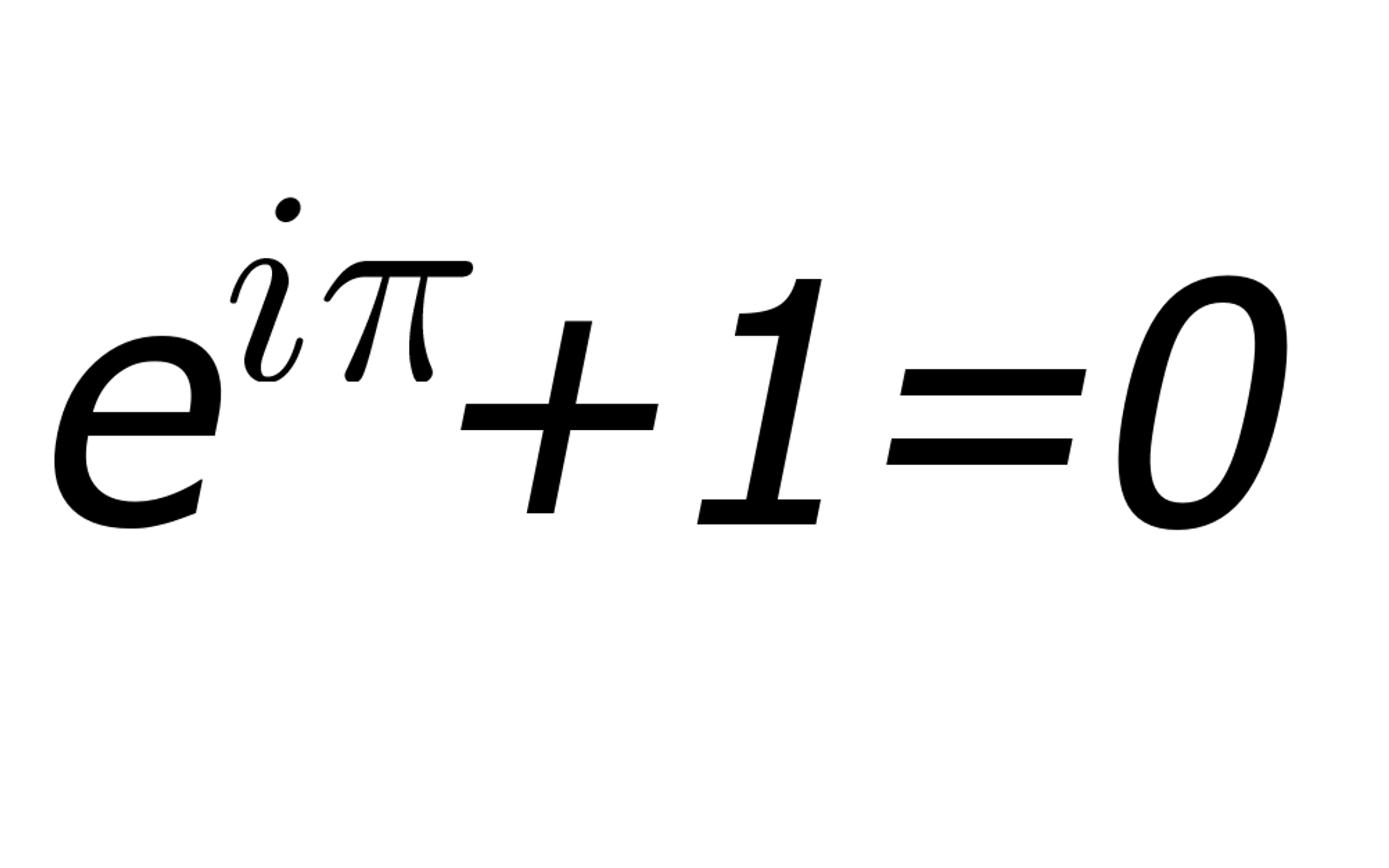
$$\\[5ex]$$ $$\text{ Exponential}$$ $$e^x = 1 + x + \frac{x^2}{2!} + \frac{x^3}{3!} + \frac{x^4}{4!} + \frac{x^5}{5!} + \dots$$ $$\\[5ex]$$ $$\text{ Cosine}$$ $$\\[5ex]$$ $$\cos(x) = 1 - \frac{x^2}{2!} + \frac{x^4}{4!} - \frac{x^6}{6!} + \dots$$ $$\\[5ex]$$ $$\text{ Sine}$$ $$\\[5ex]$$ $$\sin(x) = x - \frac{x^3}{3!} + \frac{x^5}{5!} - \frac{x^7}{7!} + \dots $$ $$\\[5ex]$$ $$\text{If, }\quad x = ix \quad \text{,in}\quad e^x \implies e^ix $$ $$\\[5ex]$$ $$e^{ix} = 1 + (ix) + \frac{(ix)^2}{2!} + \frac{(ix)^3}{3!} + \frac{(ix)^4}{4!} + \frac{(ix)^5}{5!} + \dots$$ $$\\[5ex]$$ $$\begin{aligned} \text{Since } i^2 &= -1, \\ (ix)^1 &= ix \\ (ix)^2 &= i^2 x^2 = -x^2 \\ (ix)^3 &= i^3 x^3 = -ix^3 \\ (ix)^4 &= i^4 x^4 = x^4 \\ (ix)^5 &= i^5 x^5 = ix^5 \end{aligned}$$ $$\\[5ex]$$ $$e^{ix} = 1 + ix - \frac{x^2}{2!} - \frac{ix^3}{3!} + \frac{x^4}{4!} + \frac{ix^5}{5!} - \dots$$ $$\\[5ex]$$ $$e^{ix} = \underbrace{\left( 1 - \frac{x^2}{2!} + \frac{x^4}{4!} - \dots \right)}_{\text{This is } \cos(x)} + i \underbrace{\left( x - \frac{x^3}{3!} + \frac{x^5}{5!} - \dots \right)}_{\text{This is } \sin(x)}$$ $$\\[5ex]$$ $$e^{ix} = \cos(x) + i\sin(x)$$ $$\text{If,} \quad x = \pi $$ $$\cos(\pi) = -1$$ $$\sin(\pi) = 0$$ $$\\[5ex]$$ $$e^{i\pi} = -1 + i(0)$$$$e^{i\pi} = -1$$ $$\\[5ex]$$ $$\large\boxed{e^{i\pi} + 1 = 0}$$ $$\\[10ex]$$


End


Mathematics-Code_INDEX